Test Index
CBSE Class 12 Chemistry 2018 Solved Paper
© examsnet.com
Question : 21 of 26
Marks:
+1,
-0
Define the following with an example of each : (a) Polysaccharides (b) Denatured protein (c) Essential amino acids OR (a) Write the product when D-glucose reacts with conc. . (b) Amino acids show amphoteric behaviour. Why? (c) Write one difference between -helix and -pleated structures of proteins.
Solution:
(a) Carbohydrates that give large number of monosaccharide units on hydrolysis / large number of monosaccharide units joined together by glycosidic linkage starch/ glycogen/ cellulose (or any other) (b) Proteins that lose their biological activity / proteins in which secondary and tertiary structures are destroyed Curdling of milk (or any other) (c) Amino acids which cannot be synthesised in the body. Valine/Leucine (or any other) OR (a) When D-glucose reacts with conc. , it forms saccharic acid. 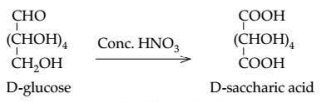 (b) In aqueous solution, the carboxyl group present in amino acid can lose a proton and the amino group can accept a proton to form zwitter ion. This zwitter ion can act both as an acid and a base showing amphoteric behaviour. (c) -helix has intramolecular hydrogen bonding while pleated has intermolecular hydrogen bonding / -helix results due to regular coiling of polypeptide chains while in pleated all polypeptide chains are stretched and arranged side by side.
© examsnet.com
Go to Question: