Test Index
Directing
Directing

 CBSE Board Videos
© examsnet.com
Question : 21 of 42
Marks:
+1,
-0
Sara recently received her degree in automobile engineering and decided to join her father's electric vehicle business. They were not only selling electric vehicles but also providing related services like charging vehicles and their maintenance, etc. Sara had worked on a practical project related to electric vehicles during her automobile engineering course and won first prize for it. She was impressed by electric vehicles because of their potential to revolutionize the automotive industry as these are more sustainable and eco-friendly alternative to traditional vehicles.She was exploring the possibility of entering into partnerships with the government for electric vehicle charging stations. This could be shared investment, with the government providing land and incentives and her company contributing technical expertise and operational management. Sara shared her thoughts and ideas with her father. She prepared a proposal to collaborate with the government for setting up electric vehicle charging stations. The proposal contained her ideas, feelings and suggestions which she intended to convey to the government. She then converted her ideas, feelings and suggestions into words and pictures. She used clear concise language and visual aids such as charts and graphs, to make complex information more understandable. She now had to choose a path through which her proposal would be transmitted to the government. Sara had a face-to-face meeting with the government and presented her ideas directly.(a) The above case highlights an element of one of the functions of management. Identify and explain the element.(b) Quoting lines from the above case, name the four elements of the concept identified in (a) above.(c) State three other elements of the concept identified in (a) above, not discussed in the above case.
[CBSE 2025 66/6/3]
Solution:
(a) Element: Communication (an element of the directing function)Communication is the process of exchange of ideas, views, facts and feelings between two or more persons so that the information is understood by the receiver in the same sense as the sender meant it. It is the basis of directing, as all instructions and ideas pass through it.(b) Elements of the communication process seen in the case (any four)1. Sender: the person who conveys the message."She prepared a proposal to collaborate with the government ..." (Sara is the sender.)2. Message: the content of ideas, feelings, suggestions or order to be conveyed."The proposal contained her ideas, feelings and suggestions which she intended to convey to the government."3. Encoding: converting the message into communication symbols such as words, pictures and gestures."She then converted her ideas, feelings and suggestions into words and pictures."4. Media: the path through which the encoded message is transmitted to the receiver."Sara had a face-to-face meeting with the government and presented her ideas directly."5. Receiver: the person who receives the communication of the sender."... which she intended to convey to the government." (The government is the receiver.)(c) Three other elements not discussed in the case1. Decoding: the process by which the receiver converts the encoded symbols of the sender back into meaning.2. Feedback: all actions or responses of the receiver indicating that he has received and understood the message of the sender.3. Noise: some obstruction or hindrance to communication, which may be caused to the sender, the message or the receiver (e.g. a poor telephone connection, faulty encoding, an inattentive receiver).The communication process: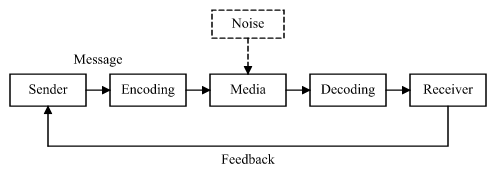
© examsnet.com
Go to Question: