Test Index
Directing
Directing

 CBSE Board Videos
© examsnet.com
Question : 15 of 42
Marks:
+1,
-0
'Capro Ltd.', an IT services firm was perceived as a passive provider focusing on fulfilling clients' orders without much innovation. In an attempt to change its image, the Chief Technical Officer of 'Capro Ltd.' called a meeting of technical heads in the conference room. The meeting was important as it was regarding launching programmes to encourage employees to generate ideas for value addition that their clients would appreciate and would help in changing the company's image.Shrinivas, a technical head was last to enter the conference room for the meeting and got a seat near the door of the conference room. As there was constant movement near the conference room, he could not attentively focus on the meeting, missing out on important points discussed in the meeting.(a) Identify and state the elements in the communication process that led to Shrinivas missing out on important points discussed in the meeting.(b) State any two other elements of the communication process other than the one identified in (a) above.
[CBSE 2025 66/7/3]
Solution:
(a) Noise"As there was constant movement near the conference room, he could not attentively focus on the meeting, missing out on important points..."Noise means any obstruction or hindrance caused to the sender, the message or the receiver in the process of communication. Here the constant movement near the door disturbed Shrinivas (the receiver), so the message did not reach him fully.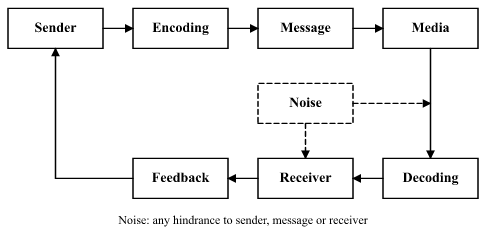 (b) Other elements of the communication process (any two):1. Sender: the person who conveys his thoughts or ideas to the receiver.2. Message: the content of ideas, feelings, suggestions, orders, etc. intended to be communicated.3. Encoding: converting the message into communication symbols such as words, pictures and gestures.4. Media: the path through which the encoded message is transmitted to the receiver (face to face, phone, letter, e-mail, etc.).5. Decoding: converting the encoded symbols of the sender back into meaning.6. Receiver: the person who receives the communication of the sender.7. Feedback: all actions of the receiver showing that he has received and understood the sender's message.
© examsnet.com
Go to Question: