Test Index
Microbes in Human Welfare
Microbes in Human Welfare

 CBSE Board Videos
© examsnet.com
Question : 25 of 29
Marks:
+1,
-0
Study the given diagram of Sewage Treatment Plant (S.T.P.) and answer the questions that follow :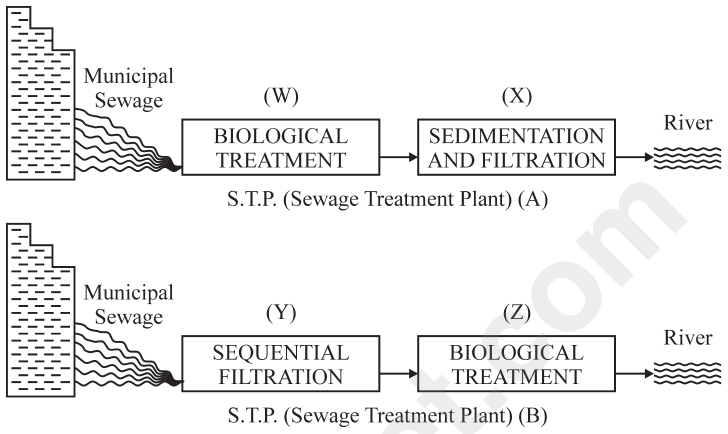 (a) Which one of the two 'S.T.P.' (A) or (B) will be more effective in treating the human excreta in the municipal waste?(b) Write the steps followed in carrying the treatment of the sewage in step (Z), once the BOD of sewage is reduced significantly till it is passed on to the "anaerobic sludge digesters".
[CBSE 2022 57/5/1]
Solution:
(a) S.T.P. (B) will be more effective.In (B) the sewage first undergoes primary treatment (sequential filtration and sedimentation remove floating debris, grit and solids), and only then the primary effluent goes for secondary (biological) treatment, where microbes digest the organic matter. In (A) biological treatment is done on raw sewage before the solids are removed, which is not effective.(b) In step (Z), after the BOD of the sewage is reduced significantly by aerobic microbes in the aeration tank:1. The effluent is passed into a settling tank.2. Here the bacterial 'flocs' (masses of bacteria with fungal filaments) are allowed to sediment. This sediment is called activated sludge.3. A small part of the activated sludge is pumped back into the aeration tank to serve as the inoculum.4. The remaining major part of the sludge is pumped into large tanks called anaerobic sludge digesters, where anaerobic bacteria digest the bacteria and fungi in the sludge, producing biogas (methane, , ).
© examsnet.com
Go to Question: