Test Index
CBSE Class 12 Biology 2026 Paper 57/4/2
CBSE Class 12 Biology 2026 Paper 57/4/2


© examsnet.com
Question : 32 of 33
Marks:
+1,
-0
(a) Study the flow chart given below. Name the hormones involved at each stage and explain their functions. (5)
Hypothalamus↓Pituitary↓Ovary↓Pregnancy
OR(b) (i) Draw a diagram of L.S. of maize grain and label its any six parts.(ii) Differentiate between perisperm and endosperm giving one example of each. (5)
Solution:
(a)1. Hypothalamus: Gonadotropin releasing hormone (GnRH). It acts on the anterior pituitary and stimulates the secretion of the gonadotropins FSH and LH.2. Pituitary (anterior): FSH and LH.FSH (follicle stimulating hormone): stimulates the growth of ovarian follicles (follicular phase) and the secretion of estrogen by the growing follicles.LH (luteinising hormone): its mid-cycle peak (LH surge) causes rupture of the Graafian follicle and release of the ovum (ovulation); it then changes the ruptured follicle into the corpus luteum.3. Ovary: estrogen and progesterone.Estrogen (from the growing follicles): regeneration and proliferation of the endometrium; helps growth of follicles.Progesterone (from the corpus luteum): maintains the endometrium, which is needed for implantation of the embryo and for the other events of pregnancy.4. Pregnancy: hCG, hPL, relaxin, and high estrogen and progesterone.The placenta secretes hCG (human chorionic gonadotropin), hPL (human placental lactogen), estrogens and progestogens; relaxin is secreted by the ovary in later pregnancy. They support foetal growth, keep the corpus luteum and endometrium working, and stop the menstrual cycle; high progesterone maintains the pregnancy.OR (b)(i)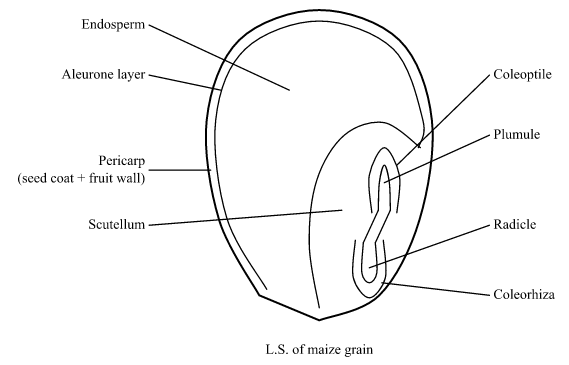 Labelled parts: pericarp (fused seed coat and fruit wall), aleurone layer, endosperm, scutellum (cotyledon), coleoptile, plumule, radicle, coleorhiza.(b)(ii)
| Perisperm | Endosperm |
| Residual (left-over) nucellus that persists in the seed. | Nutritive tissue formed from the primary endosperm cell after triple fusion. |
| Diploid (2n). | Usually triploid (3n). |
| Example: black pepper, beet. | Example: wheat, maize, castor, coconut. |
© examsnet.com
Go to Question: