Test Index
CBSE Class 12 Biology 2026 Paper 57/3/3
CBSE Class 12 Biology 2026 Paper 57/3/3


© examsnet.com
Question : 30 of 33
Marks:
+1,
-0
Read the following passage and answer the questions that follow :India is one of the megadiverse countries housing around 8·1 per cent of global species diversity, although its land area is only 2·4 per cent of the world's land area. Many of the species are highly threatened due to human activities like deforestation, mining and habitat fragmentation. Laws like Wildlife (Protection) Act, 1972 were enacted by the Government of India to preserve our biological wealth. Various conservation measures are being implemented to save the threatened species.The following bar graph shows the number of species conserved under different biodiversity conservation methods.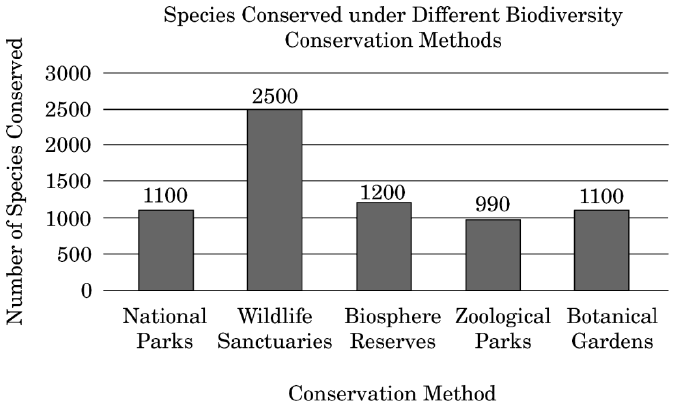 Study the graph and answer the questions.(a) Which method conserves the highest number of species ? Is it ex situ or in situ conservation ?(b) Which other methods shown in the diagram are opposite to the one identified by you in question (a) ? How are these two conservation approaches different ?(c) (i) Write two features of Biodiversity hotspots.OR(c) (ii) To which category do sacred groves belong and how do they help in bio-conservation ?
Solution:
(a) Wildlife sanctuaries conserve the highest number of species (2500). This is in situ (on-site) conservation, because the organisms are protected in their natural habitat.(b) The opposite (ex situ) methods in the graph are Zoological parks and Botanical gardens. (National parks and biosphere reserves are also in situ, like sanctuaries.)
(c)(i) Features of biodiversity hotspots (any two):1. Very high level of species richness.2. High degree of endemism (many species found nowhere else).3. They are regions that are also under threat of heavy habitat loss. (Hotspots cover less than 2 per cent of the earth's land area but hold a very large share of its species; India has three: the Western Ghats and Sri Lanka, Indo-Burma and the Himalaya.)OR (c)(ii) Sacred groves belong to in situ conservation. They are tracts of forest set aside by local communities for religious reasons, where all the trees and wildlife are venerated and given total protection (e.g. Khasi and Jaintia Hills in Meghalaya, Aravalli Hills of Rajasthan, Western Ghat regions of Karnataka and Maharashtra, Sarguja, Chanda and Bastar areas of Madhya Pradesh). They therefore act as refuges for many rare and threatened plants and animals.
| In situ conservation | Ex situ conservation |
| Organisms are protected in their natural habitat. | Organisms are taken out of their natural habitat and kept in special settings (zoos, botanical gardens, seed banks). |
| The whole ecosystem is protected, so diversity at all levels (genetic, species, ecosystem) is conserved. | Mainly selected threatened or endangered species are given special care and protection. |
© examsnet.com
Go to Question: