Test Index
CBSE Class 12 Biology 2026 Paper 57/3/3
CBSE Class 12 Biology 2026 Paper 57/3/3


© examsnet.com
Question : 28 of 33
Marks:
+1,
-0
(a) What is the carrying capacity of a species in a habitat?(b) Explain the growth curve that takes this capacity into account.
Solution:
(a)Carrying capacity (K) is the maximum population size of a species that a habitat can support with its available (limited) resources. Beyond it, no further growth is possible.(b)Logistic growth (Verhulst-Pearl logistic growth)A population growing in a habitat with limited resources shows initially a lag phase, followed by phases of acceleration and deceleration, and finally an asymptote, when the population density reaches the carrying capacity K. A plot of N against time t gives a sigmoid (S-shaped) curve.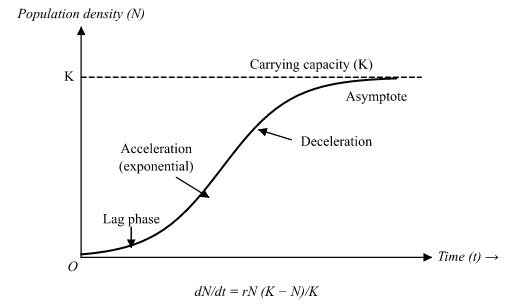 It is described by the equation:where = population density at time , = intrinsic rate of natural increase, = carrying capacity.As approaches , the factor approaches , so the growth rate falls to zero and the population levels off. This model is more realistic than exponential growth, because resources in nature are always limited.
© examsnet.com
Go to Question: