Test Index
CBSE Class 12 Biology 2026 Paper 57/3/3
CBSE Class 12 Biology 2026 Paper 57/3/3


© examsnet.com
Question : 19 of 33
Marks:
+1,
-0
Study the schematic cross between male and female honey bee given below and answer the questions that follow.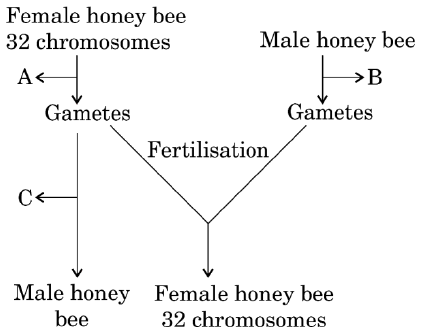 (a) Identify the cell division 'A' and 'B' that leads to gamete formation.(b) Name the process 'C' that leads to development of honey bee.(c) What type of sex-determination pattern is this?
Solution:
Concept: In honey bees, the female (queen or worker) is diploid () and the male (drone) is haploid ().(a)A: Meiosis (the diploid female forms haploid eggs, , by meiosis).B: Mitosis (the haploid male forms haploid sperms, , by mitosis).(b)C: Parthenogenesis: an unfertilised egg develops into a male (drone) by parthenogenesis, so males have 16 chromosomes. A fertilised egg (zygote, 32 chromosomes) develops into a female.(c)Haplodiploid sex-determination system: sex depends on the number of chromosome sets an individual receives (diploid = female, haploid = male). Males have no father and cannot have sons, but have a grandfather and can have grandsons.
© examsnet.com
Go to Question: