Test Index
CBSE Class 12 Biology 2026 Paper 57/3/3
CBSE Class 12 Biology 2026 Paper 57/3/3


© examsnet.com
Question : 17 of 33
Marks:
+1,
-0
(a) (i) Given below is the schematic representation of the process of electrophoresis. Identify the alphabets representing the :(I) Anode end, and(II) Lightest/Smallest DNA in matrix.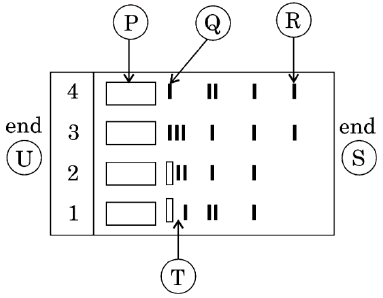 (ii) What is Agarose gel and why is it used in this process?OR(b) After performing gel electrophoresis, a student observes that DNA fragments are not visible.(i) Suggest a reason for this and explain how fragments can be made visible.(ii) Also explain how a specific DNA fragment can be collected from the gel for further use.
Solution:
(a)(i)Concept: DNA is negatively charged, so in an electric field it moves from the wells (cathode end) towards the anode. The gel acts as a sieve: the smaller the fragment, the farther it moves.The wells (P) lie at end U, so U is the cathode end and the DNA bands move towards S.(I) Anode end: S(II) Lightest/smallest DNA: R (the band that has moved farthest from the well, nearest the anode).(a)(ii)Agarose is a natural polysaccharide polymer extracted from sea weeds. Agarose gel is used as the matrix because it has a sieving effect: DNA fragments move through it according to their size, smaller fragments moving faster and farther, so the fragments get separated by size.OR (b)(b)(i)Reason: DNA fragments are not visible in the gel by themselves; the gel was not stained with ethidium bromide (or not exposed to UV light).Making them visible: stain the gel with ethidium bromide and expose it to UV radiation. The separated DNA fragments then appear as bright orange-coloured bands.(b)(ii)The band containing the desired DNA fragment is cut out from the agarose gel and the DNA is extracted from the gel piece. This step is called elution. The purified DNA fragment can then be used to construct recombinant DNA by joining it with a cloning vector.
© examsnet.com
Go to Question: