Test Index
CBSE Class 12 Biology 2025 Paper 57/5/1
CBSE Class 12 Biology 2025 Paper 57/5/1


© examsnet.com
Question : 33 of 33
Marks:
+1,
-0
(a) (i) Explain the structure of a typical monocotyledonous embryo of a flowering plant.(ii) How are multiple embryos formed in a citrus fruit ? What is the mechanism known as ?OR(b) (i) Name and explain the structural organisation of the male sex accessory ducts in the human male reproductive system.(ii) Describe the role of gonadotropin FSH in the regulation of spermatogenesis.
Solution:
(a)(i) Structure of a monocot (grass) embryo:1. It has only one cotyledon, called the scutellum in the grass family, situated towards one side (laterally) of the embryonal axis.2. At its lower end the embryonal axis has the radicle and the root cap, enclosed in an undifferentiated sheath called the coleorhiza.3. The portion of the embryonal axis above the level of attachment of the scutellum is the epicotyl.4. The epicotyl has the shoot apex and a few leaf primordia, enclosed in a hollow foliar structure, the coleoptile.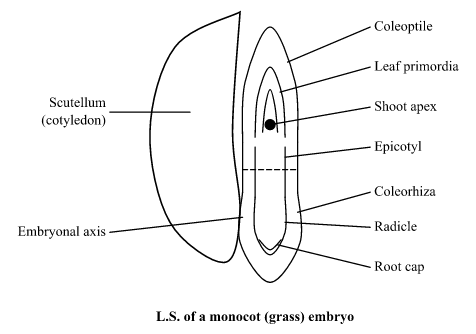 (a)(ii) In citrus, some of the nucellar cells surrounding the embryo sac start dividing, protrude into the embryo sac and develop into embryos. So each ovule contains many embryos (besides the zygotic one), and the seed has multiple embryos. The occurrence of more than one embryo in a seed is called polyembryony; since these nucellar embryos form without fertilisation, the mechanism is a form of apomixis (adventive embryony). Such embryos are genetically identical to the parent.OR (b)(i) The male sex accessory ducts are the rete testis, vasa efferentia, epididymis and vas deferens:1. Rete testis: the seminiferous tubules of the testis open into the vasa efferentia through the rete testis.2. Vasa efferentia: these leave the testis and open into the epididymis.3. Epididymis: a coiled tube located along the posterior surface of each testis, where sperms are stored and mature; it leads to the vas deferens.4. Vas deferens: it ascends to the abdomen and loops over the urinary bladder. It receives a duct from the seminal vesicle and opens into the urethra as the ejaculatory duct.Path of sperms: seminiferous tubules → rete testis → vasa efferentia → epididymis → vas deferens → ejaculatory duct → urethra → urethral meatus. These ducts store and transport the sperms from the testis to the outside through the urethra.(b)(ii) Spermatogenesis starts at puberty when the hypothalamus increases the secretion of GnRH, which acts on the anterior pituitary and stimulates the release of the gonadotropins LH and FSH.Role of FSH: FSH acts on the Sertoli cells of the seminiferous tubules and stimulates the secretion of some factors which help in the process of spermiogenesis (transformation of spermatids into sperms), a part of spermatogenesis. Sertoli cells also nourish the developing germ cells.(LH, in turn, acts on the Leydig cells and stimulates the synthesis and secretion of androgens, which stimulate spermatogenesis.)
© examsnet.com
Go to Question: