Test Index
CBSE Class 12 Biology 2025 Paper 57/5/1
CBSE Class 12 Biology 2025 Paper 57/5/1


© examsnet.com
Question : 31 of 33
Marks:
+1,
-0
(a) Define transgenic animals. Explain in detail any four areas where they can be used for human benefit.OR(b) Describe the structure and working of a sparged stirred-tank bioreactor.
Solution:
(a)Transgenic animals: animals whose DNA has been manipulated to possess and express an extra (foreign) gene. Examples: transgenic rats, rabbits, pigs, sheep, cows and fish; over 95 per cent of existing transgenic animals are mice.Areas of use for human benefit (any four):1. Normal physiology and development: transgenic animals are designed to study how genes are regulated and how they affect the normal functions of the body and its development, e.g. the study of complex factors involved in growth such as insulin-like growth factor (the gene that alters its formation is introduced and its effect studied).2. Study of disease: many transgenic animals are made as models of human diseases, so that the role of genes in the development of a disease can be understood and new treatments tried, e.g. models for cancer, cystic fibrosis, rheumatoid arthritis and Alzheimer’s disease.3. Biological products: transgenic animals carrying the gene for a useful human protein produce it, often in their milk, e.g. human protein α-1-antitrypsin (used to treat emphysema). In 1997 the first transgenic cow, Rosie, produced milk containing human α-lactalbumin (2.4 g per litre), nutritionally a more balanced product for human babies than natural cow milk.4. Vaccine safety: transgenic mice are used to test the safety of vaccines before they are used on humans, e.g. the polio vaccine. If successful, they can replace monkeys for such tests.5. Chemical safety testing (toxicity testing): transgenic animals carry genes that make them more sensitive to toxic substances than normal animals; they are exposed to the substances and the effects are studied, so results are obtained in less time.OR (b)Bioreactors are large vessels (100-1000 litres) in which raw materials are converted into specific products (enzymes, proteins) by microbial, plant, animal or human cells, under optimal conditions. They are used for large-scale production after a gene is cloned.Structure:1. A cylindrical vessel (or one with a curved base) that holds the culture medium.2. A stirrer (motor-driven shaft with flat-bladed impellers) for mixing.3. A sparger: a perforated pipe or ring at the bottom through which sterile air is bubbled.4. Control systems: an agitator system, an oxygen delivery system, a foam control system, a temperature control system (cooling jacket), a pH control system (acid/base inlet).5. Sampling ports through which small volumes of the culture can be withdrawn periodically.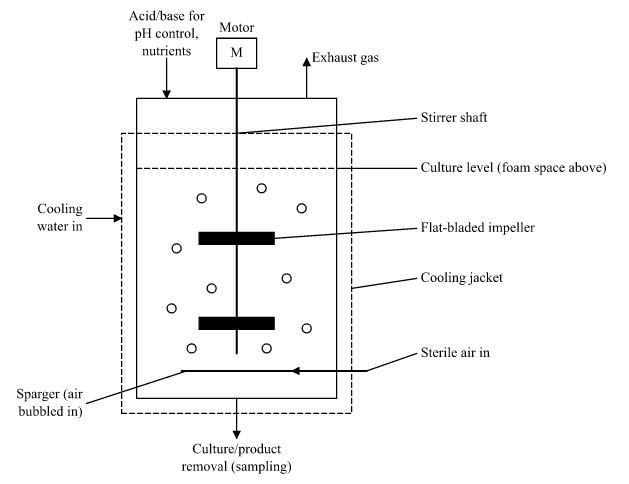 Working:1. The vessel is filled with sterile medium and inoculated with the cells that carry the cloned gene.2. The stirrer mixes the contents evenly so that every cell gets nutrients and oxygen, and heat is spread uniformly.3. Sterile air is bubbled in through the sparger; the bubbles greatly increase the area for oxygen transfer, so oxygen reaches the whole culture (better than a simple stirred tank).4. Temperature, pH and foam are kept at the best values by their control systems, and salts and vitamins are added as needed, giving optimal growth conditions.5. Samples are withdrawn through the sampling ports to check growth; the product is finally taken out and sent for downstream processing (separation, purification, formulation, quality control).
© examsnet.com
Go to Question: