Test Index
CBSE Class 12 Biology 2025 Paper 57/5/1
CBSE Class 12 Biology 2025 Paper 57/5/1


© examsnet.com
Question : 28 of 33
Marks:
+1,
-0
Many of the flowering plants producing hermaphrodite flowers have developed many devices to discourage self-pollination and to encourage cross-pollination. Given below is a picture of one such outbreeding device in a flowering plant. Study the picture and answer the questions that follow :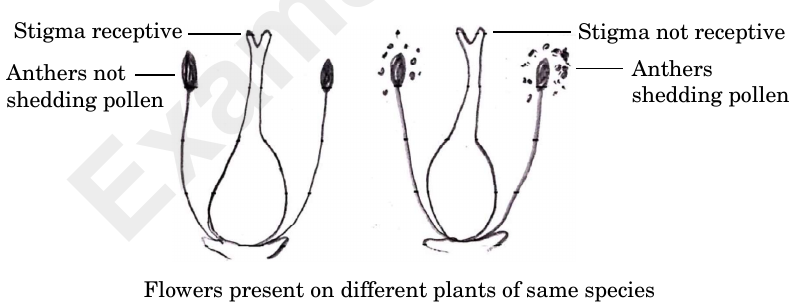 (a) Explain how the given type of pollination is advantageous to the plant.(b) Can this flowering plant show geitonogamy ? Justify your answer.
Solution:
Concept: The picture shows an outbreeding device in which pollen release and stigma receptivity are not synchronised (dichogamy): when the stigma is receptive the anthers are not shedding pollen, and when the anthers shed pollen the stigma is no longer receptive. So pollen must come from a flower of another plant (cross-pollination, xenogamy).(a)Cross-pollination (xenogamy) is advantageous because:• It brings genetically different pollen to the stigma, so the offspring show genetic variation (new combinations).• It prevents inbreeding depression (loss of vigour and fertility caused by continued self-pollination).• It promotes hybrid vigour and better adaptability of the progeny.(b)No, this plant will not show geitonogamy.Justification: Geitonogamy is the transfer of pollen from the anther to the stigma of another flower of the same plant. In this plant pollen release and stigma receptivity are not synchronised, and, as the figure shows, the flowers in the receptive (stigma) stage and in the pollen-shedding stage are on different plants. When the stigmas of a plant are receptive, no flower of that plant is shedding pollen, so pollen of the same plant cannot pollinate it; only pollen from a different plant can reach a receptive stigma.Key point: Non-synchrony prevents geitonogamy only when all flowers of one plant are in the same phase, as shown here. If flowers of one plant opened at different times, geitonogamy could still occur.
© examsnet.com
Go to Question: