Test Index
CBSE Class 12 Biology 2025 Paper 57/5/1
CBSE Class 12 Biology 2025 Paper 57/5/1


© examsnet.com
Question : 18 of 33
Marks:
+1,
-0
Given below are the diagrammatic representations of the replicating fork of DNA in E. coli. Study the diagrams and answer the questions that follow.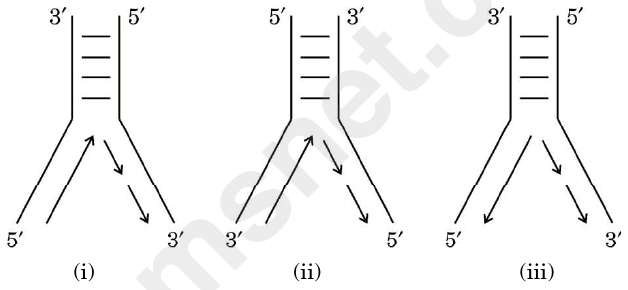 (a) Which one of the three diagrams (i), (ii) or (iii) is the correct representation of the replicating fork of DNA replication ? Explain your answer.(b) Name the enzyme used in E. coli to join the newly synthesised fragments of DNA.
Solution:
(a)Diagram (ii) is the correct replicating fork.Explanation:• DNA-dependent DNA polymerase can polymerise nucleotides in only one direction, (the new strand grows at its 3′ end), so it reads the template in the direction.• On the template with polarity (in the direction the fork moves), synthesis can follow the opening fork, so it is continuous (leading strand, one long arrow pointing towards the fork).• On the template with polarity , synthesis must go away from the fork, so it is discontinuous (lagging strand, short Okazaki fragments pointing away from the fork).• In (ii), the left template runs (open end) to (top), so its new strand is continuous and grows towards the fork; the right template runs (open end) to (top), so its new strand is made as short fragments away from the fork. Both are shown correctly.• In (i) and (iii) the left template has its end at the open end; its new strand must be discontinuous, but it is drawn continuous, and the right strand is drawn discontinuous although it should be continuous. So (i) and (iii) are wrong.(b)DNA ligase joins the discontinuously synthesised fragments (Okazaki fragments).
© examsnet.com
Go to Question: