Test Index
CBSE Class 12 Biology 2025 Paper 57/1/1
CBSE Class 12 Biology 2025 Paper 57/1/1


© examsnet.com
Question : 29 of 33
Marks:
+1,
-0
Study the graphs given below for Case 1 and Case 2 showing different levels of certain hormones and answer the question that follows :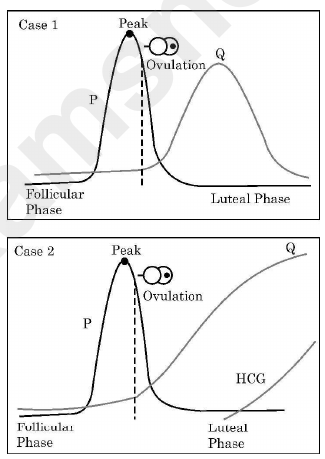 (a) Which hormone is responsible for the peak observed in Case 1 and Case 2 ? Write one function of that hormone.(b) Write changes that take place in the ovary and uterus during follicular phase.Student to attempt either sub-part (c) or (d) :(c) Name the hormone Q of Case 2. Write one function of hormone Q.OR(d) Which structure in the ovary will remain functional in Case 2 ? How is it formed ?
Solution:
Concept: Case 1 is a normal menstrual cycle (no fertilisation). Case 2 shows hCG rising in the luteal phase, so fertilisation and implantation have taken place (pregnancy).(a)Hormone P with the peak is luteinising hormone (LH) (the LH surge in the middle of the cycle).Function: the LH surge induces rupture of the Graafian follicle and release of the ovum (ovulation); LH also changes the ruptured follicle into the corpus luteum.(b) Follicular (proliferative) phase:• Ovary: under FSH and LH the primary follicles grow and one becomes a fully mature Graafian follicle, which secretes oestrogen.• Uterus: under oestrogen the endometrium regenerates and proliferates (becomes thick and vascular).(c)Q is progesterone (secreted by the corpus luteum).Function: it maintains the endometrium, which is needed for implantation of the embryo and for the maintenance of pregnancy.OR (d)The corpus luteum remains functional in Case 2.Formation: after ovulation the remaining parts (cells) of the ruptured Graafian follicle transform into the corpus luteum. In pregnancy hCG keeps it active, so it does not degenerate and goes on secreting progesterone.
© examsnet.com
Go to Question: