Test Index
CBSE Class 12 Biology 2024 Paper 57/3/2
CBSE Class 12 Biology 2024 Paper 57/3/2


© examsnet.com
Question : 28 of 33
Marks:
+1,
-0
A population of snakes lived in a desert with brown sand. Study the drawings given below showing the change in the population from 'one' to 'two' over time and answer the question that follows. Brown snakes and Grey snakes are represented by alleles A/a (Dominant/recessive).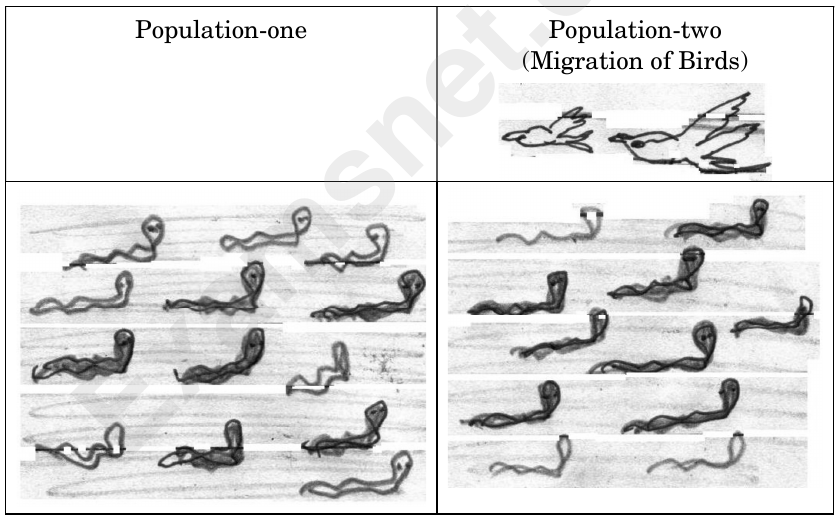 (a) If the frequency of the recessive trait is 9% in population-one, work out the frequency of homozygous dominant and heterozygous dominant snakes.(b) Name the mechanism of evolution that must have operated so that population-two evolved from population-one.
Solution:
(a) By the Hardy-Weinberg principle,where p = frequency of allele A (brown), q = frequency of allele a (grey), = AA, = Aa and = aa.Given: frequency of the recessive trait (grey snakes, aa) = 9% = 0.09Solution:, so Homozygous dominant (AA) Heterozygous dominant (Aa) Result: AA = 0.49 (49%), Aa = 0.42 (42%). (Check: 0.49 + 0.42 + 0.09 = 1.)(b) Natural selection (directional selection by predation). Grey snakes stand out against the brown sand, so the migrating birds pick them off more easily, while the brown snakes are camouflaged. The brown snakes survive and reproduce more, so the frequency of allele A rises and population-two has mostly brown snakes.
© examsnet.com
Go to Question: