Test Index
CBSE Class 12 Biology 2024 Paper 57/3/2
CBSE Class 12 Biology 2024 Paper 57/3/2


© examsnet.com
Question : 17 of 33
Marks:
+1,
-0
(a) Write important features of 'humus' formed during the decomposition cycle in a terrestrial ecosystem.OR(b) (i) Graphically represent the relationship between species richness and area on a log-log scale for bats and fishes.(ii) Write the equation for the relationship as on a logarithmic scale.
Solution:
(a)Humus is formed from detritus by humification during decomposition. Its important features:1. It is a dark-coloured, amorphous (shapeless) substance.2. It is highly resistant to microbial action.3. It undergoes decomposition at an extremely slow rate.4. It is colloidal in nature.5. It serves as a reservoir of nutrients; on slow mineralisation it releases inorganic nutrients into the soil.OR (b)(i) Within a region, species richness increases with the explored area, but only up to a limit. On normal axes this gives a rectangular hyperbola (). When species richness and area are both plotted on a log-log scale, the relationship becomes a straight line. The same kind of straight line is obtained for any group, such as bats or fishes; its slope is Z.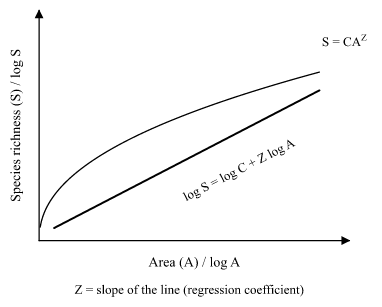 (ii) where S = species richness, A = area, Z = slope of the line (regression coefficient) and C = Y-intercept. For small areas Z is usually 0.1 to 0.2; for very large areas such as whole continents the line is steeper (Z about 0.6 to 1.2).
© examsnet.com
Go to Question: