Test Index
CBSE Class 12 Biology 2023 Paper 57/5/2
CBSE Class 12 Biology 2023 Paper 57/5/2


© examsnet.com
Question : 33 of 33
Marks:
+1,
-0
(a) (i) Explain the monosporic development of embryo sac in the ovule of an angiosperm. (3)(ii) Draw a diagram of the mature embryo sac of an angiospermic ovule and label any four parts in it. (2)OR(b) (i) Explain the formation of placenta after the implantation in a human female. (3)(ii) Draw a diagram showing human foetus within the uterus and label any four parts in it. (2)
Solution:
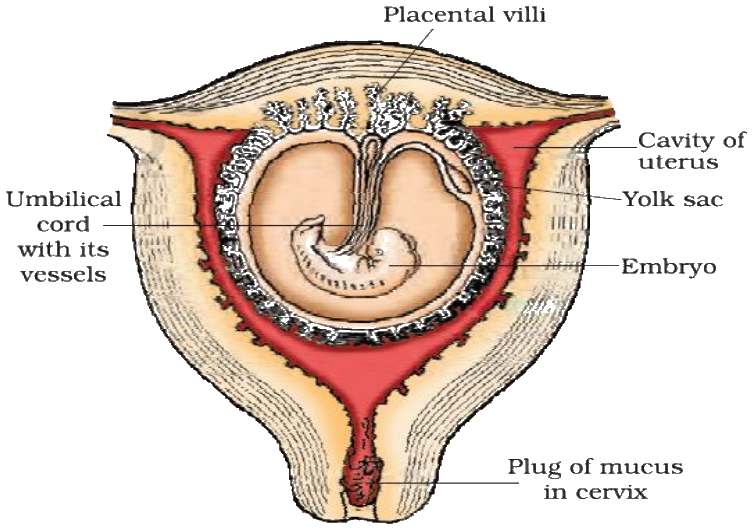
(a)(i) Monosporic development of the embryo sac:1. The megaspore mother cell (MMC, 2n), in the micropylar region of the nucellus, undergoes meiosis and forms a linear tetrad of four haploid megaspores (n).2. In most flowering plants three megaspores degenerate and only one remains functional. The embryo sac develops from this single megaspore, hence 'monosporic'.3. The nucleus of the functional megaspore divides mitotically to form two nuclei, which move to opposite poles (2-nucleate embryo sac).4. Two more free-nuclear mitotic divisions (without cell wall formation) at each pole give the 4-nucleate and then the 8-nucleate stage.5. Cell walls then form, organising the typical female gametophyte (embryo sac): six of the eight nuclei are surrounded by cell walls; the remaining two (polar nuclei) lie in the large central cell. Three cells at the micropylar end form the egg apparatus (two synergids and one egg cell) and three cells at the chalazal end are the antipodals.So the mature embryo sac is 7-celled and 8-nucleate.(a)(ii) Mature embryo sac: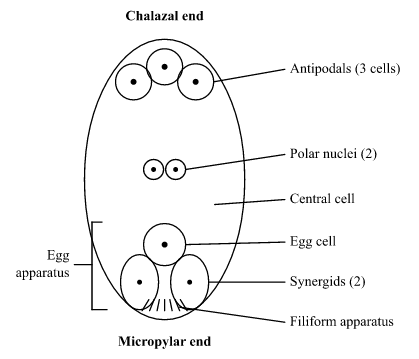 OR (b)(i) Formation of placenta:1. After implantation of the blastocyst in the endometrium, finger-like projections called chorionic villi appear on the trophoblast.2. The chorionic villi are surrounded by the uterine tissue and maternal blood.3. The chorionic villi and the uterine tissue become interdigitated with each other and jointly form a structural and functional unit between the developing embryo (foetus) and the maternal body, called the placenta.4. The placenta is connected to the embryo through the umbilical cord. It supplies oxygen and nutrients to the embryo and removes carbon dioxide and excretory wastes; it also acts as an endocrine tissue (hCG, hPL, oestrogens, progestogens).(b)(ii) Human foetus within the uterus:
© examsnet.com
Go to Question: