Test Index
CBSE Class 12 Biology 2023 Paper 57/5/2
CBSE Class 12 Biology 2023 Paper 57/5/2


© examsnet.com
Question : 30 of 33
Marks:
+1,
-0
When a microorganism invades a host, a definite sequence of events usually occur leading to infection and disease, causing suffering to the host. This process is called pathogenesis. Once a microorganism overcomes the defense system of the host, development of the disease follows a certain sequence of events as shown in the graph. Study the graph given below for the sequence of events leading to appearance of a disease and answer the questions that follow :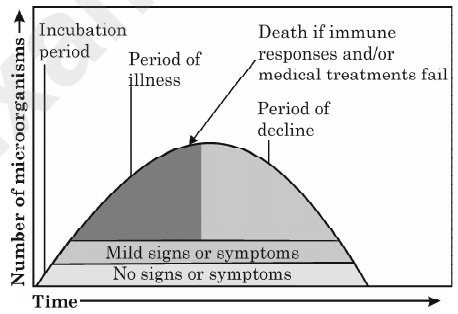 (a) In which period, according to the graph there are maximum chances of a person transmitting a disease / infection and why ? (1)(b) Study the graph and write what is an incubation period. Name a sexually transmitted disease that can be easily transmitted during this period. Name the specific type of lymphocytes that are attacked by the pathogen of this disease. (2)OR(b) Draw a schematic labelled diagram of an antibody. (2)(c) In which period, the number of immune cells forming antibodies will be the highest in a person suffering from pneumonia ? (1)Name the immune cells that produce antibodies.
Solution:
(a)Incubation period. The person is already infected and the pathogens are multiplying, but there are no signs or symptoms. So the person does not know he/she is ill, takes no precautions, and mixes freely with others, which can spread the infection.(During the period of illness the number of microorganisms is highest, so a patient can also transmit the disease, e.g. by droplet infection.)(b)Incubation period: the time between the entry of the pathogen into the body (infection) and the appearance of the first symptoms of the disease. In the graph it is the first part, where microorganisms increase but there are no signs or symptoms.Sexually transmitted disease: AIDS (incubation period from a few months to many years, 5-10 years).Lymphocytes attacked: helper T-lymphocytes ( cells) by HIV.OR (b)An antibody is a Y-shaped molecule made of four polypeptide chains: two small light chains and two longer heavy chains (), joined by disulphide bonds. The two tips of the arms are the antigen binding sites.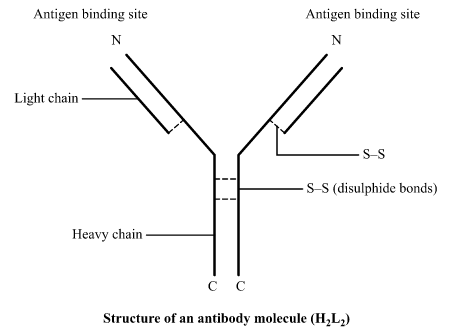 (c)Period of illness: the number of microorganisms is highest here, so the body's immune response is strongest and the number of antibody-forming cells is highest.Immune cells that produce antibodies: B-lymphocytes (B-cells; the plasma cells formed from them).
© examsnet.com
Go to Question: