Test Index
CBSE Class 12 Biology 2023 Paper 57/3/1
CBSE Class 12 Biology 2023 Paper 57/3/1


© examsnet.com
Question : 33 of 33
Marks:
+1,
-0
(a) Given below is a diagrammatic representation of a human ovum.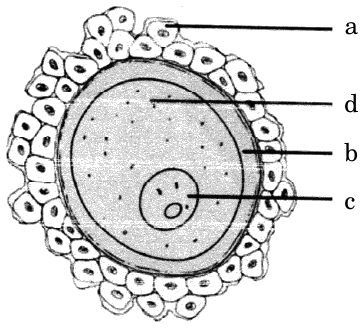 (i) Identify the parts ‘a’, ‘b’ and ‘c’.(ii) This ovum is released from the ovary with incomplete meiotic division. When, where and how is the meiotic division completed ?(iii) How does an ovum ensure the entry of a single sperm during fertilisation ?OR(b) (i) Double fertilisation is an event unique to all flowering plants. Explain the process.(ii) Give a reason for the following :(1) A seed of an orange has many embryos.(2) Cashew is a false fruit but Guava is a true fruit.
Solution:
(a)(i) a: Cells of the corona radiata (follicle cells)b: Zona pellucidac: Haploid nucleus(a)(ii) The ovum is released as a secondary oocyte, arrested in meiosis II.When: the second meiotic division is completed only when a sperm enters the cytoplasm of the ovum (at fertilisation).Where: in the ampullary region of the fallopian tube (oviduct), where fertilisation takes place.How: the entry of the sperm induces the completion of meiosis II of the secondary oocyte. This is an unequal division: it forms a small second polar body and a large haploid ovum (ootid).(a)(iii) During fertilisation, as a sperm comes in contact with the zona pellucida layer of the ovum, it induces changes in the membrane that block the entry of additional sperms. This ensures that only one sperm fertilises an ovum.OR (b)(i) Double fertilisation:After entering a synergid of the embryo sac, the pollen tube releases two male gametes.1. Syngamy: one male gamete fuses with the egg cell nucleus to form the diploid zygote, which develops into the embryo.2. Triple fusion: the other male gamete fuses with the two polar nuclei in the central cell to form the triploid primary endosperm nucleus (PEN), which develops into the endosperm.Since two types of fusion, syngamy and triple fusion, take place in one embryo sac, the event is called double fertilisation; it is unique to flowering plants.(b)(ii)(1) Orange shows polyembryony (apomixis): some of the nucellar cells surrounding the embryo sac start dividing, protrude into the embryo sac and develop into embryos. So one seed has many embryos (besides the zygotic one).(b)(ii)(2) In cashew, the thalamus also contributes to fruit formation along with the ovary, so it is a false fruit. In guava (as stated) the fruit develops only from the ovary after fertilisation, so it is a true fruit.
© examsnet.com
Go to Question: