Test Index
CBSE Class 12 Biology 2023 Paper 57/1/1
CBSE Class 12 Biology 2023 Paper 57/1/1


© examsnet.com
Question : 30 of 33
Marks:
+1,
-0
Study the diagrammatic representation given below of the Earth with regions marked 'A' and 'B' respectively. Answer the questions that follow.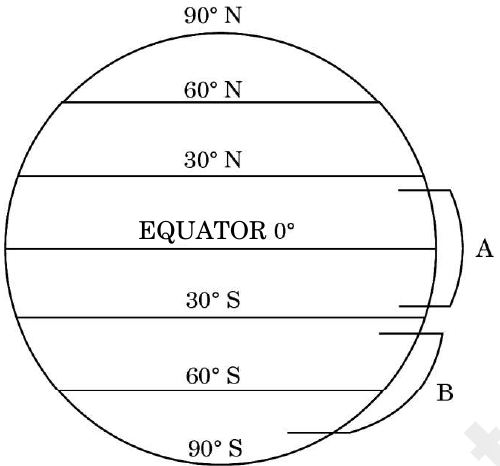 (a) Write the observations made regarding the species diversity when moving from region 'A' to region 'B'. Give two reasons also. (3)(b) Stating the reason, mention the approximate number of bird species recorded in India. (1)OR(b) Name the region in the world that records the greatest biodiversity and mention why. (1)
Solution:
(a) Region A is the tropics (around the equator) and region B lies at higher latitudes towards the pole. Species diversity decreases as we move from region A to region B (from the equator towards the poles); the tropics have far more species than temperate or polar regions.Reasons (any two):1. Tropical latitudes have remained relatively undisturbed for millions of years (no frequent glaciations), giving a long evolutionary time for species diversification.2. Tropical environments are less seasonal, relatively constant and predictable, which promotes niche specialisation and greater species diversity.3. More solar energy is available in the tropics, giving higher productivity, which in turn supports greater diversity.(b) India has more than 1200 species of birds, because the Indian land mass lies largely in the tropical latitudes.OR (b) The Amazonian rainforest in South America has the greatest biodiversity on Earth, mainly because it lies in the tropical region (warm, stable climate and high productivity).
© examsnet.com
Go to Question: