Test Index
CBSE Class 12 Biology 2023 Paper 57/1/1
CBSE Class 12 Biology 2023 Paper 57/1/1


© examsnet.com
Question : 19 of 33
Marks:
+1,
-0
(a) (i) Identify and name the structures 'A' and 'B' marked in the image given below :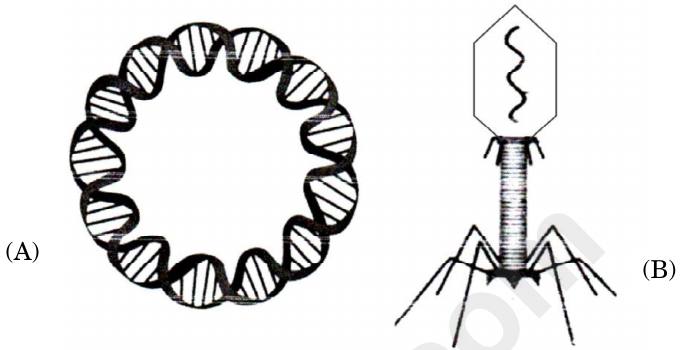 (ii) State their importance in various biotechnology experiments.OR(b) Explain the process by which a bacterial cell can be made 'competent' to take up foreign DNA from its surroundings, using divalent cations and temperature treatment.
Solution:
(a)(i) A – plasmid (circular, extra-chromosomal double-stranded DNA of a bacterium).B – bacteriophage (a virus that infects bacteria).(a)(ii) Both are used as cloning vectors: they carry a desired foreign gene (alien DNA) into the host cell.They have an origin of replication and replicate within bacterial cells independently of the chromosomal DNA, so the linked gene is multiplied to many copies (plasmids may have many copies per cell; bacteriophages have very high copy numbers).Plasmids also carry selectable markers (such as antibiotic resistance genes) that help to identify transformants.OR (b) DNA is hydrophilic and cannot pass through the cell membrane, so the bacterial cell is first made competent:1. The bacterial cells are treated with a specific concentration of a divalent cation such as calcium (). This increases the efficiency with which DNA enters the bacterium through pores in its cell wall.2. The cells are then incubated with the recombinant DNA on ice.3. They are given a brief heat shock at .4. They are placed back on ice. The heat shock helps the bacteria take up the recombinant DNA.
© examsnet.com
Go to Question: