Test Index
CBSE Class 12 Biology 2022 Paper 57/5/1
CBSE Class 12 Biology 2022 Paper 57/5/1


© examsnet.com
Question : 6 of 13
Marks:
+1,
-0
(a) (i) Write the observations made at the end of Connell's field experiment on barnacles on the rocky sea coasts of Scotland.(ii) Name any two categories of organisms that in general are adversely affected by competition.OR(b) The graphs (X) and (Y) given below depict the diurnal variations in the solar radiations in the month of June (Summer) and in December (Winters) :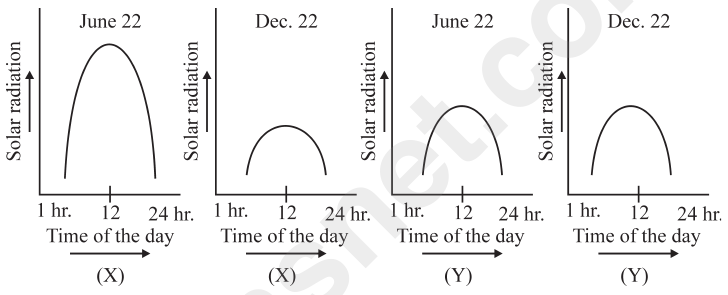 (i) Which of the two graphs depicts tropical region and temperate regions respectively ?(ii) Which of the two regions (X) or (Y) will show high biological diversity and why?
Solution:
(a)(i) In Connell's field experiment on the rocky sea coasts of Scotland, the larger and competitively superior barnacle Balanus dominated the intertidal area and excluded the smaller barnacle Chthamalus from that zone (competitive exclusion).(a)(ii) Herbivores and plants are, in general, adversely affected by competition (more than carnivores).OR (b)(b)(i) Graph (Y) depicts the tropical region and graph (X) depicts the temperate region. In (Y) the solar radiation in June and in December is almost the same, as in the tropics, where the sun is high all through the year. In (X) the radiation in December is much lower than in June, showing the strong seasonal change of temperate latitudes.(b)(ii) Region (Y), the tropical region, shows high biological diversity, because:1. It has less seasonal variation and a relatively constant, predictable environment, which promotes niche specialisation and greater species diversity.2. More solar energy is available, which supports higher productivity.3. Tropical latitudes remained undisturbed (not glaciated) for millions of years, giving a long evolutionary time for species diversification.
© examsnet.com
Go to Question: