Test Index
CBSE Class 12 Biology 2022 Paper 57/5/1
CBSE Class 12 Biology 2022 Paper 57/5/1


© examsnet.com
Question : 13 of 13
Marks:
+1,
-0
(a) Cloning of genes, play a very significant role in genetic engineering, helping the transfer of desirable foreign genes into different hosts. The scientists, to make this process easier and effective are creating engineered vectors in such a way that they help easy linking of foreign DNA and selection of recombinants from non recombinants. 'pBR322' is one such engineered vectors developed by scientists. A diagram of an engineered vector pBR322 is given below :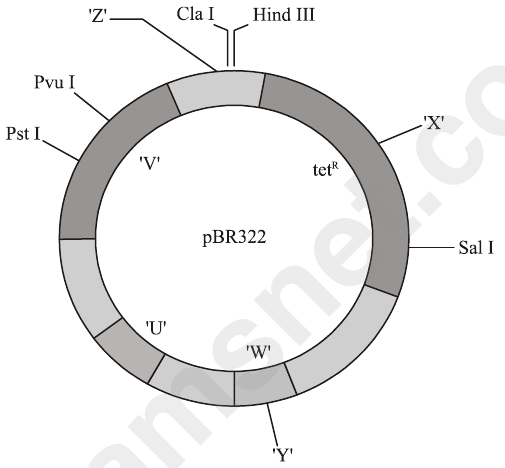 (i) Name the host for this cloning vector.(ii) Identify 'Rop' and 'Ori' in the diagram from 'U', 'V', 'W', 'X', 'Y' and 'Z'. Write their functions.(iii) Draw the fragments that will be formed by the action of 'Z' (marked in the diagram) on the specific site of the DNA segment given below :5' --- GTACGAATTCCTGA---3'3'---CATGCTTAAGGACT---5'OR(b) RNA interference (RNAi) holds great potential as a therapeutic agent for the treatment of human diseases and as biocontrol agents in controlling pests in the field of agriculture. An experiment was carried to study the use of 'RNAi' for the potential treatment of disorders of cholesterol metabolism. Some people possess genetic mutations with elevated levels of ApoB gene which predisposes them to coronary artery diseases.Lowering the amount of ApoB can reduce the number of lipoproteins and lower the blood cholesterol.Tracy Zimmerman and her colleagues used RNAi in 2006 to reduce the level of ApoB in non human primates Cynomolgus monkeys.One group of monkeys were given RNAi treatment (small interfering RNAs, SiRNAs) (doses 1 mg/kg SiRNAs), second group of monkeys were given RNAi treatment (doses 2.5 mg/kg SiRNAs) and third group of monkeys were injected with saline.The results of the study are depicted in the graph below :
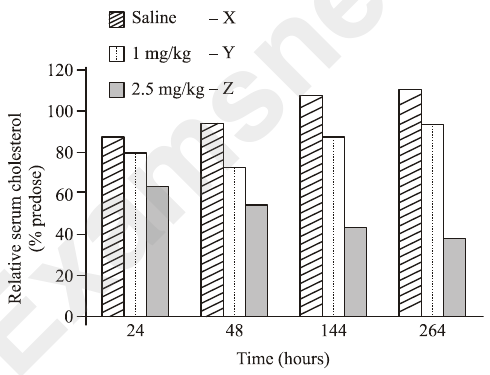 (i) How does the treatment with 2.5 mg/kg brings an effect on cholesterol metabolism when compared from 24 hours and 144 hours.(ii) Write any two natural sources from where dsRNA molecule could be obtained for silencing the specific mRNA.(iii) How is RNAi used in controlling the infection on the roots of tobacco plants by the nematode Meloidogyne incognita.
Solution:
(a)(i) The host for pBR322 is the bacterium Escherichia coli (E. coli).(a)(ii)'W' = rop: codes for the proteins involved in the replication of the plasmid.'U' = ori: the origin of replication, the sequence from where replication starts; it also controls the copy number of the linked DNA.(a)(iii) 'Z' is the restriction enzyme EcoRI. It recognises the palindromic sequence 5'-GAATTC-3' and cuts each strand between G and A, leaving sticky ends:5'-GTACG|AATTCCTGA-3'3'-CATGCTTAA|GGACT-5'Fragments formed:5'-GTACG-3' 5'-AATTCCTGA-3'3'-CATGCTTAA-5' 3'-GGACT-5'Each fragment has a single-stranded 5'-AATT overhang (sticky end).OR (b)(b)(i) With 2.5 mg/kg siRNA, the relative serum cholesterol falls from about 63% of the predose level at 24 hours to about 43% at 144 hours. So the treatment brings a considerable, progressive decrease in serum cholesterol with time (while saline-treated monkeys show no fall), because the siRNA silences the ApoB mRNA and fewer lipoproteins are made.(b)(ii) Natural sources of dsRNA:1. Infection by viruses having RNA genomes (RNA viruses / retroviruses).2. Mobile genetic elements (transposons) that replicate via an RNA intermediate.(b)(iii)1. Using Agrobacterium vectors, nematode-specific genes are introduced into the tobacco (host) plant.2. The introduced DNA produces both sense and anti-sense RNA in the host cells.3. These two RNAs are complementary to each other and form a double-stranded RNA (dsRNA).4. The dsRNA initiates RNAi and silences the specific mRNA of the nematode.5. As a result the parasite cannot survive in the transgenic host expressing the specific interfering RNA, and the plant is protected from Meloidogyne incognita.
© examsnet.com
Go to Question: