Test Index
CBSE Class 12 Biology 2022 Paper 57/4/1
CBSE Class 12 Biology 2022 Paper 57/4/1


© examsnet.com
Question : 13 of 13
Marks:
+1,
-0
(a) There are two different farm lands, one where Bt-cotton crop was cultivated and the other where non Bt-cotton crop (indigenous) was cultivated. Farmers responsible for this experimental cultivation were free to use the farming practices of their choice. During the cultivation period, the data was collected with respect to the amount of pesticide used, water required for irrigation and at harvesting time, the crop productivity. Based on the data collected, a bar graph was plotted which is shown below.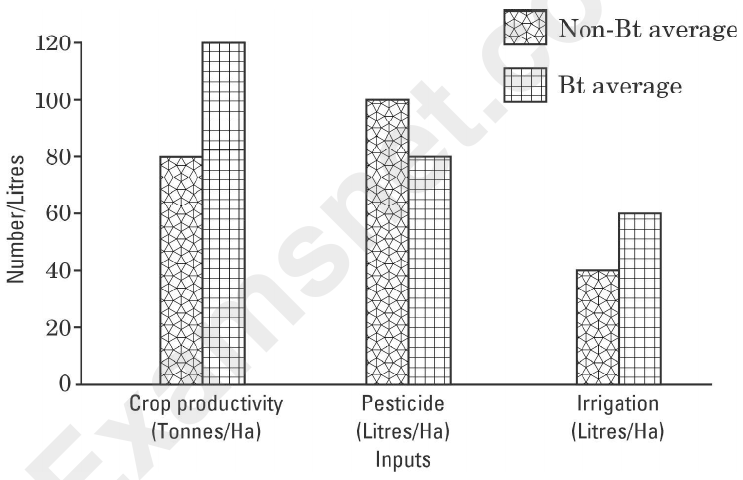 Answer the following questions :(i) Write your interpretation, with reason, on the basis of the three parameters plotted in the graph.(ii) Which one of the crops would you like to cultivate in your farm and why ?(iii) Which one out of these two crops would a farmer from Rajasthan like to cultivate and why ?OR(b) Gene of interest/alien gene is introduced by a cloning vector into a host cell to bring about a desired phenotypic expression in a host cell. The cloning vectors used are plasmid and bacteriophages. Biotechnologists in their labs, for desired results engineered specialised cloning vectors. One such vector is pBR322. Study the diagram carefully and answer the questions that follow. ()
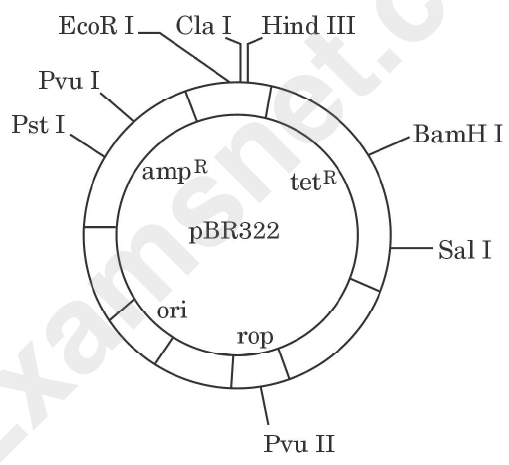 (i) What do ‘EcoR I’, ‘BamH I’ and ‘Hind III’ represent ? State their functions.(ii) Identify the gene you would select for the role of a selectable marker in pBR322. Explain why.(iii) Write the property/characteristic of plasmid and bacteriophage that makes them efficient cloning vectors.(iv) Biotechnologists always insert ‘ori’ gene in their engineered cloning vector. Justify the statement.(v) Will the experiment be successful if the alien DNA is ligated at Hind III restriction site ? Give reason in support of your answer.
Solution:
(a)(i) Interpretation of the three parameters:• Crop productivity: Bt cotton gives about 120 tonnes/ha against about 80 for non-Bt cotton, i.e. much higher, because the crop is protected from bollworms and suffers less pest damage.• Pesticide: Bt cotton needs about 80 L/ha against about 100 L/ha, i.e. less pesticide, because the plant makes its own Bt toxin; this saves money and is environment-friendly.• Irrigation: Bt cotton needs about 60 L/ha against about 40 L/ha, i.e. more water than the non-Bt crop.(a)(ii) I would cultivate Bt cotton: weighing all the parameters, it gives a higher yield with less pesticide; the benefit of higher output and lower pesticide cost outweighs the extra water, provided irrigation is available.(a)(iii) A farmer from Rajasthan would prefer the non-Bt (indigenous) cotton, because Rajasthan is an arid region with shortage of water, and the non-Bt crop needs less irrigation water than the Bt crop.OR (b)(i) EcoR I, BamH I and Hind III are restriction endonucleases (shown at their recognition/restriction sites on pBR322). They act as molecular scissors: each recognises a specific palindromic nucleotide sequence and cuts the DNA at a specific site within it, so the vector and the foreign DNA can be cut to give matching (sticky) ends.(b)(ii) The antibiotic resistance genes ampR (ampicillin resistance) and tetR (tetracycline resistance) act as selectable markers. They help to identify and select transformants from non-transformants: only cells that have taken up pBR322 grow on a medium containing the antibiotic. If the foreign DNA is inserted within one of these genes (e.g. at BamH I in tetR), that resistance is lost (insertional inactivation), which also lets recombinants be told apart from non-recombinants.(b)(iii) Plasmids and bacteriophages replicate independently of the chromosomal DNA within bacterial cells (autonomous replication) and have a high copy number per cell, so the gene of interest linked to them is also made in a large number of copies.(b)(iv) ori is the origin of replication, the sequence from which replication starts. Any DNA linked to this sequence can replicate inside the host cell, and ori also controls the copy number of the linked DNA. Without ori the vector (and the alien gene) could not multiply, so it is always included.(b)(v) No. In the map, the Hind III site lies outside both selectable marker genes (ampR and tetR). Inserting the alien DNA there inactivates neither gene, so recombinant and non-recombinant plasmids give the same antibiotic-resistance pattern; the recombinants cannot be identified and selected, so the experiment will not succeed.
© examsnet.com
Go to Question: