Test Index
CBSE Class 12 Biology 2022 Paper 57/2/3
CBSE Class 12 Biology 2022 Paper 57/2/3


© examsnet.com
Question : 3 of 13
Marks:
+1,
-0
(a) Study the given graphs (X) and (Y) depicting the annual variation in solar radiation on Earth from January to December and answer the undermentioned questions.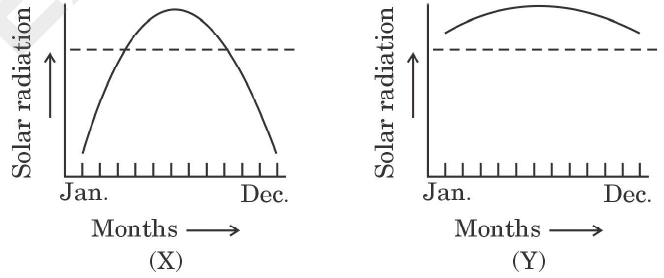 (i) Identify the graph that depicts (I) tropical region, and (II) temperate region, respectively.(ii) Which of the two regions, (X) or (Y), will show high biological diversity and why ? Give two reasons.OR(b) (i) When prickly pear cactus was introduced into Australia in early 1920s, it caused havoc and ecosystem instability by achieving very high population densities. Explain the reason for its rapid spread into millions of hectares of rangeland.(ii) State the importance of 'Prey-predator' relationship in a habitat.
Solution:
(a)(i) (I) Tropical region: graph (Y); (II) Temperate region: graph (X).In the tropics the solar radiation is high and nearly the same all through the year (flat curve Y). In temperate regions it is high only in summer and falls sharply in winter (curve X with a sharp peak).(a)(ii) Region (Y), the tropical region, shows higher biological diversity. Reasons:1. Tropical environments are less seasonal, relatively more constant and predictable. Such constant environments promote niche specialisation and lead to greater species diversity.2. More solar energy is available in the tropics, which contributes to higher productivity; this in turn contributes indirectly to greater diversity.(Also, tropical latitudes have remained relatively undisturbed for millions of years, unlike temperate regions that faced frequent glaciations, so there was a long time for species diversification.)OR (b)(i) The prickly pear cactus was an exotic (introduced) species in Australia. There it had no natural predators (herbivores) to keep its numbers in check, so it multiplied without control and spread over millions of hectares of rangeland. It was brought under control only after a cactus-feeding predator (a moth) from its natural habitat was introduced into the country.(b)(ii) Importance of the prey-predator relationship (any two):1. Predators act as conduits for energy transfer across trophic levels.2. They keep prey populations under control; otherwise prey species could reach very high densities and cause ecosystem instability.3. Predators help in maintaining species diversity in a community by reducing the intensity of competition among competing prey species.4. Predators are 'prudent': if a predator over-exploits its prey, the prey may become extinct and the predator too will die out for lack of food.
© examsnet.com
Go to Question: