Test Index
CBSE Class 12 Biology 2022 Paper 57/2/3
CBSE Class 12 Biology 2022 Paper 57/2/3


© examsnet.com
Question : 13 of 13
Marks:
+1,
-0
(a) Development of recombinant DNA technology has opened gates to many breakthroughs in the fields of medicine and agriculture. This has enabled scientists to isolate, sequence and manipulate individual genes obtained from diverse living or dead cells. Given below is a diagram showing the basic steps involved in genetically modifying an organism. Study the given diagram and answer the questions that follow :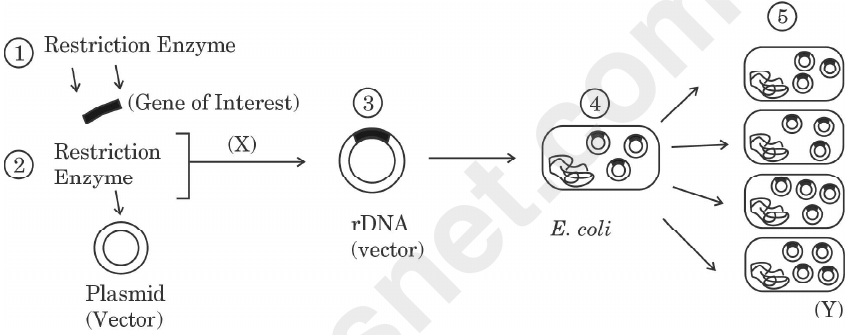 (i) Are two different types of restriction endonucleases used, one to cut the vector DNA and another to cut the desired DNA to be cloned ? Support your answer, giving reason.(ii) Which enzyme is used at step (X) to integrate the foreign DNA with the vector DNA ?(iii) What is the term used for step (Y) showing multiple copies of the foreign DNA being formed in transformed E. coli ?(iv) Draw a diagram of E. coli cloning vector pBR322 to show the following :(I) Any one restriction endonuclease site in tetracycline resistance gene(II) Any one restriction endonuclease site in ampicillin resistance gene(III) 'ori' site(v) What does "rop" code for in plasmid pBR322 ? (5×1=5)OR(b) RNA interference (RNAi) holds great potential as a therapeutic agent for the treatment of human diseases and as a biocontrol agent for controlling pests in the agricultural fields. An experiment was conducted to study the use of 'RNAi' for the potential treatment of disorders of cholesterol metabolism. Some people possess genetic mutations with elevated levels of 'ApoB' gene which predisposes them to coronary artery diseases.Lowering the amount of 'ApoB' can reduce the number of lipoproteins and lower the blood cholesterol.Tracy Zimmerman and her colleagues used RNAi in 2006 to reduce the level of 'ApoB' in non-human primates Cynomolgus monkeys. (i) One group of monkeys were given RNAi treatment (Small interfering RNAs, SiRNAs) (doses 1 mg/kg SiRNAs), (ii) Second group of monkeys were given RNAi treatment (doses 2.5 mg/kg SiRNAs), and (iii) Third group of monkeys were injected saline as control.The results of the experiments are illustrated in the graph given below :
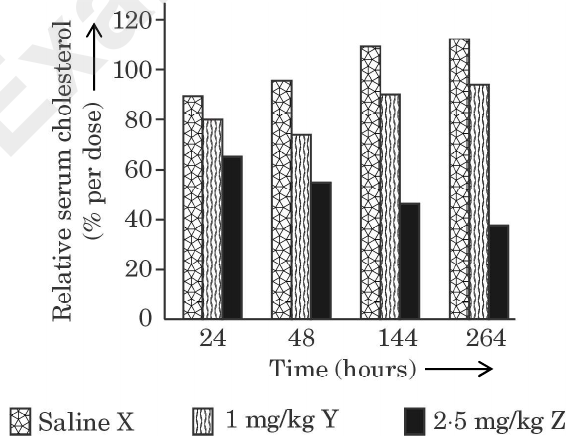 (i) What do you interpret from the bars (X and Z) obtained after 264 hours of treatment of monkeys with saline and 2.5 mg/kg SiRNAs treatment ?(ii) Name the category of organisms in the living world, where RNA interference (RNAi) takes place. Why ?(iii) What is the basic principle involved in RNA interference (RNAi) in silencing the preferred genes ?
Solution:
(a)(i) No. The vector DNA and the desired (foreign) DNA are cut with the same restriction endonuclease. Then both carry the same kind of complementary sticky ends, which can pair with each other (by hydrogen bonds) and be joined end to end by DNA ligase to form recombinant DNA.(a)(ii) DNA ligase joins the foreign DNA with the vector DNA at step (X).(a)(iii) Step (Y) is cloning (gene cloning): the recombinant DNA replicates in the transformed E. coli and makes many identical copies of the foreign DNA.(a)(iv) E. coli cloning vector pBR322: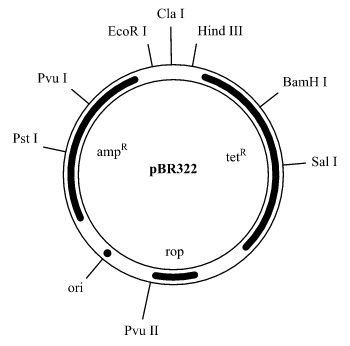 (I) Restriction site in the tetracycline resistance gene (tetR): BamH I (or Sal I).(II) Restriction site in the ampicillin resistance gene (ampR): Pst I (or Pvu I).(III) ori: origin of replication.(a)(v) rop codes for the proteins involved in the replication of the plasmid.OR (b)(i) After 264 hours, in the saline (control) group X the serum cholesterol has kept rising (to about 112%), while in group Z (2.5 mg/kg siRNA) it has fallen to about 38%. So the siRNA silenced the ApoB gene and lowered blood cholesterol; the effect grows with time and is dose dependent (the 1 mg/kg group Y stays only a little below the control).(b)(ii) RNA interference takes place in all eukaryotic organisms. It is a method of cellular defence: it protects the cell from foreign nucleic acids such as viruses with RNA genomes and mobile genetic elements (transposons) that pass through an RNA intermediate.(b)(iii) RNAi involves silencing of a specific mRNA by a complementary double-stranded RNA (dsRNA). The dsRNA binds to the complementary mRNA of the target gene and prevents its translation, so the protein is not formed and the gene is silenced.
© examsnet.com
Go to Question: