Test Index
The Human Eye and the Colourful World
The Human Eye and the Colourful World

 CBSE Board Videos
© examsnet.com
Question : 8 of 39
Marks:
+1,
-0
(A) (i) How does the change in curvature of the eye lens helps us in the process of seeing the nearby objects clearly ?(ii) State the range of the power of accommodation of a normal human eye.OR(B) Draw a ray diagram to show the correction of eye defect of an old man who can not see an object placed closer than 1 m from his eye, clearly.
[CBSE 2026 31/5/1]
Solution:
(A)(i)To see a nearby object, the ciliary muscles contract. The eye lens becomes thicker, so its curvature increases and its focal length decreases. The lens then converges the rays more strongly and the image of the nearby object is formed on the retina, so it is seen clearly. This ability of the eye lens to adjust its focal length is called accommodation.(A)(ii)A normal eye can see objects clearly from the near point, about cm, up to the far point at infinity. So the range of accommodation (range of vision) of a normal eye is cm to infinity. (In terms of power, the eye lens changes its power by about D between these two limits.)OR (B)The man's near point has moved to m: he has hypermetropia (old age, presbyopia). It is corrected by a convex lens that makes rays from an object at cm (N) appear to come from his near point N' at m, where he can see clearly.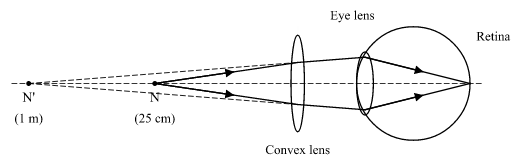 Power of the lens: cm, cm, so cmResult: Convex lens of power D
© examsnet.com
Go to Question: