Test Index
The Human Eye and the Colourful World
The Human Eye and the Colourful World

 CBSE Board Videos
© examsnet.com
Question : 5 of 39
Marks:
+1,
-0
Attempt either (a) or (b) :(a) What happens when light is scattered from (i) very fine particles and (ii) very large size particles of medium ? Justify your answer in each case.OR(b) With the help of a ray diagram, explain any phenomenon of formation of spectrum in nature.
[CBSE 2026 31/3/1]
Solution:
(a)(i) Very fine particles (such as air molecules) scatter mainly light of shorter wavelengths, i.e. the blue end of the spectrum. So the scattered light looks blue. This is why the clear sky appears blue.(a)(ii) Very large particles (larger than the wavelength of light, such as water droplets of clouds or dust) scatter light of all wavelengths almost equally. So the scattered light looks white. This is why clouds look white.OR (b) Rainbow is a natural spectrum seen in the sky after a rain shower, in the direction opposite to the Sun.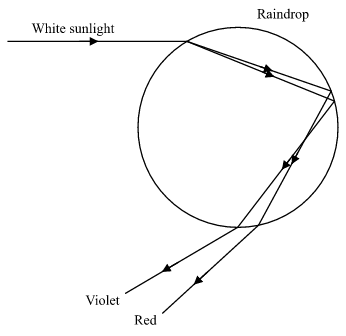 Tiny water droplets in the air act like small prisms:1. Sunlight refracts and disperses into its colours as it enters a droplet.2. The light is reflected internally at the back of the droplet.3. It refracts again as it comes out of the droplet, and the colours separate further.Because each colour leaves at a slightly different angle, an observer with the Sun behind sees the colours as a band, red on the outside and violet on the inside.
© examsnet.com
Go to Question: