Test Index
The Human Eye and the Colourful World
The Human Eye and the Colourful World

 CBSE Board Videos
© examsnet.com
Question : 21 of 39
Marks:
+1,
-0
(a) Study the diagram given below and answer the questions that follow :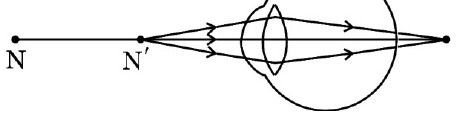 (i) Name the defect of vision depicted in this diagram stating the part of the eye responsible for this condition.(ii) List two causes of this defect.(iii) Name the type of lens used to correct this defect and state its role in this case.OR(b) What is dispersion of white light ? State its cause. Draw a diagram to show dispersion of a beam of white light by a glass prism.
[CBSE 2024 31/5/1]
Solution:
(a)(i) The defect is hypermetropia (far-sightedness). The near point has moved from N (normal, ) to N', farther away, and light from a nearby object is focused behind the retina.Part responsible: the eye lens (with its ciliary muscles), which cannot become converging enough; or the eyeball has become too short.(ii) Causes:1. The focal length of the eye lens is too long.2. The eyeball has become too small.(iii) It is corrected with a convex (converging) lens of suitable power. The convex lens provides the additional focusing (converging) power needed, so that the image of a nearby object is formed on the retina.OR (b)Dispersion: The splitting of white light into its constituent colours (VIBGYOR) is called dispersion.Cause: Different colours of light bend through different angles with respect to the incident ray when they pass through a prism (the refractive index of glass is different for different colours). Red bends the least and violet the most.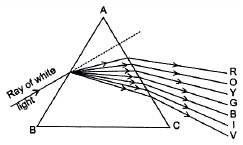 Dispersion of a beam of white light by a glass prism ABC: the spectrum shows R, O, Y, G, B, I, V from top to bottom.
© examsnet.com
Go to Question: