Test Index
The Human Eye and the Colourful World
The Human Eye and the Colourful World

 CBSE Board Videos
© examsnet.com
Question : 15 of 39
Marks:
+1,
-0
A person allowed a narrow beam of white light from the sun to enter a dark room through a small aperture and placed a glass prism in its path in such a manner that the beam falls on the face AB of the prism as shown in the figure.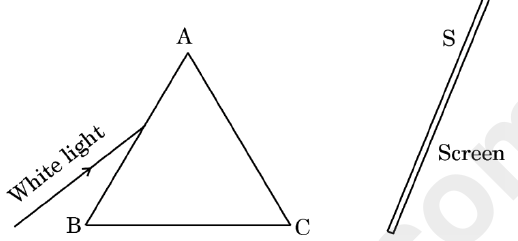 A screen S is placed on the other side of the prism, facing AC. On turning the prism slowly, a beautiful band of colours is obtained on the screen. It is the spectrum of sunlight.(a) Name the phenomenon due to which a prism splits the incident white light into a band of colours.(b) State the reason of getting a band of seven colours in the above case.(c) (i) Explain with the help of a labelled ray diagram, an experimental arrangement to show the recombination of the spectrum of white light.OR(c) (ii) Draw a labelled ray diagram to show the formation of a rainbow.
[CBSE 2025 31/2/2]
Solution:
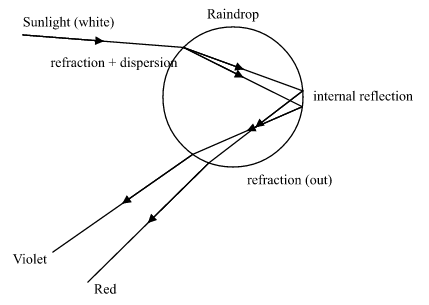
(a)Dispersion of light: the splitting of white light into its component colours.(b)White light is made of seven colours (VIBGYOR). On passing through the prism, the different colours bend through different angles with respect to the incident ray, because the glass has a slightly different refractive index for each colour. Red bends the least and violet the most, so the colours separate and form a band of seven colours on the screen.(c)(i)Take two identical glass prisms. Place the second prism in an inverted position with respect to the first, close to it (Newton's arrangement).The first prism disperses white light into its seven colours. The second, inverted prism bends each colour by the same amount in the opposite direction, so all the colours recombine. A beam of white light emerges from and white light is seen on the screen. This shows that sunlight is made of seven colours.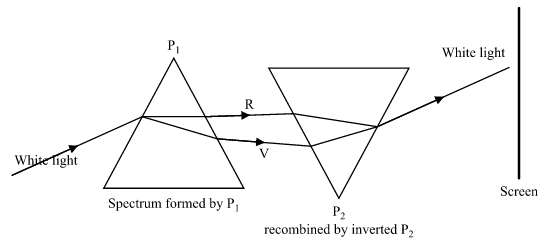 OR (c)(ii)A rainbow is formed by tiny water droplets in the atmosphere, which act like small prisms. It is seen in the sky opposite the sun, after a shower.At each droplet sunlight undergoes:1. Refraction and dispersion when it enters the drop,2. Internal reflection at the back surface of the drop,3. Refraction again when it comes out of the drop.The different colours come out at different angles and reach the observer's eye, forming the rainbow.
© examsnet.com
Go to Question: