Test Index
Metals and Non-metals
Metals and Non-metals

 CBSE Board Videos
© examsnet.com
Question : 31 of 47
Marks:
+1,
-0
The melting points and boiling points of some ionic compounds are given below :
These compounds are termed ionic because they are formed by the transfer of electrons from a metal to a non-metal. The electron transfer in such compounds is controlled by the electronic configuration of the elements involved. Every element tends to attain a completely filled valence shell of its nearest noble gas or a stable octet.(i) Show the electron transfer in the formation of magnesium chloride. (1)(ii) List two properties of ionic compounds other than their high melting and boiling points. (1)(iii) (A) While forming an ionic compound say sodium chloride how does sodium atom attain its stable configuration ? (2)OR(iii) (B) Give reasons : (2)(i) Why do ionic compounds in the solid state not conduct electricity ?(ii) What happens at the cathode when electricity is passed through an aqueous solution of sodium chloride ?
| Compound | Melting Point (K) | Boiling Point (K) |
| 1074 | 1686 | |
| 887 | 1600 | |
| 1045 | 1900 | |
| 2850 | 3120 | |
| 981 | 1685 |
[CBSE 2023 31/4/2]
Solution:
(i) Mg (2, 8, 2) loses its two valence electrons, one to each Cl atom (2, 8, 7):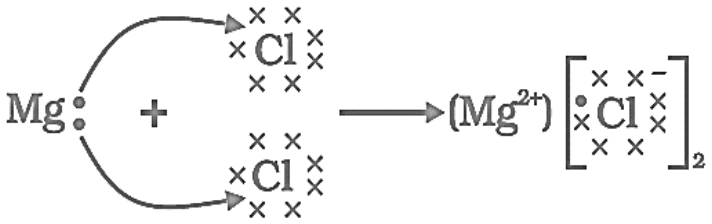 and , giving , i.e. .(ii) Properties of ionic compounds (any two):1. They are hard solids (strong attraction between oppositely charged ions).2. They are generally soluble in water and insoluble in kerosene and petrol.3. They conduct electricity in the molten state or in aqueous solution.(iii) (A)Sodium (2, 8, 1) has one electron in its outermost shell. By losing this electron it attains the stable configuration of its nearest noble gas, neon (2, 8), and forms the sodium cation:(2, 8, 1) → (2, 8)The electron is taken by chlorine, which becomes (2, 8, 8).OR (iii) (B)(i) In the solid state the ions are held in fixed positions in a rigid structure and cannot move. Conduction needs moving charged particles, so solid ionic compounds do not conduct.(ii) At the cathode, hydrogen gas is liberated: (overall: )
© examsnet.com
Go to Question: