Test Index
Metals and Non-metals
Metals and Non-metals

 CBSE Board Videos
© examsnet.com
Question : 3 of 47
Marks:
+1,
-0
Attempt either (a) or (b):(a) (i) Write one example each of one metal that is so soft that it can be cut with a knife, and one non-metal that is a good conductor of electricity.(ii) Using the electronic configuration, explain how Mg atom combines with oxygen to form magnesium oxide by transfer of electrons. [Atomic number: Mg = 12, O = 8]OR(b) Give reasons:(i) Metal sulphides and carbonates should be converted to their metal oxides in the process of extraction of metals.(ii) Aluminium oxide is considered as an amphoteric oxide.(iii) Metals like Na, K, Ca and Mg are never found in their free state in nature.
[CBSE 2026 31/2/1]
Solution:
(a)(i)Soft metal that can be cut with a knife: sodium (or potassium, lithium).Non-metal that is a good conductor of electricity: graphite (a form of carbon).(a)(ii)Electronic configurations: Mg (12) = 2, 8, 2 and O (8) = 2, 6.Magnesium loses its two valence electrons to get the stable octet of neon: (2, 8, 2 2, 8)Oxygen gains these two electrons to complete its octet: (2, 6 2, 8)The oppositely charged ions and are held together by strong electrostatic attraction, forming the ionic compound magnesium oxide, .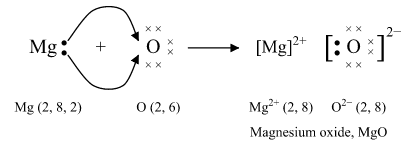 OR (b)(b)(i)It is easier to obtain a metal from its oxide (by reduction with carbon) than from its sulphide or carbonate. So sulphide ores are roasted and carbonate ores are calcined to change them into oxides, e.g. (roasting) (calcination)(b)(ii)Aluminium oxide reacts with both acids and bases to form salt and water, so it shows both acidic and basic behaviour (amphoteric): (sodium aluminate)(b)(iii)Na, K, Ca and Mg are very reactive metals (high in the reactivity series). They react readily with oxygen, water and other substances around them, so in nature they are always found in the combined state as compounds (oxides, chlorides, carbonates), never free.
© examsnet.com
Go to Question: