Test Index
Magnetic Effects of Electric Current
Magnetic Effects of Electric Current

 CBSE Board Videos
© examsnet.com
Question : 40 of 40
Marks:
+1,
-0
AB is a coil of copper wire having a large number of turns. The ends of the coil are connected with a galvanometer as shown. When the north pole of a strong bar magnet is moved towards the end B of the coil, a deflection is observed in the galvanometer.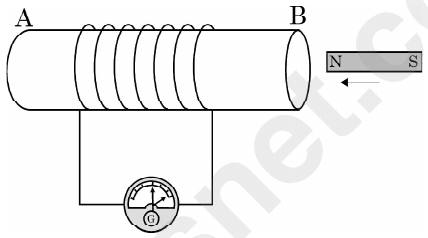 (a) State the reason for using galvanometer in the activity and why does its needle deflects momentarily when magnet is moved towards the coil.(b) What would be observed in the galvanometer in a situation when the coil and the bar magnet both move with the same speed in the same direction ? Justify your answer.(c) State the conclusion that can be drawn from this activity.Will there be any change in the momentary deflection in the galvanometer if number of turns in the coil is increased and a more stronger magnet is moved towards the coil ?ORWhat is electromagnetic induction ? What is observed in the galvanometer when a strong bar magnet is held stationary near one end of a coil of large number of turns ? Justify your answer.
[CBSE 2022 31/4/1]
Solution:
(a)A galvanometer is used to detect the presence of a current in the circuit and its direction.When the magnet moves towards the coil, the magnetic field linked with the coil changes. This change induces a potential difference and a current in the coil, so the needle deflects. The current flows only while the field is changing (while the magnet is moving), so the deflection is momentary.(b)No deflection in the galvanometer.Justification: When the coil and the magnet move with the same speed in the same direction, there is no relative motion between them. The magnetic field linked with the coil does not change, so no current is induced.(c)Conclusion: Relative motion between a magnet and a coil (a changing magnetic field linked with the coil) produces an induced potential difference, which sets up an induced current in the circuit. The induced current lasts only as long as the relative motion continues. This is electromagnetic induction.Yes, the momentary deflection will increase (still momentary). A larger number of turns and a stronger magnet both give a larger change in the magnetic field linked with the coil, so a larger current is induced.ORElectromagnetic induction: The process by which a changing magnetic field in a conductor induces a current (potential difference) in it (or in another conductor) is called electromagnetic induction.Observation: There is no deflection in the galvanometer when the magnet is held stationary near the coil.Justification: There is no relative motion between the magnet and the coil, so the magnetic field linked with the coil does not change. Without a change in the magnetic field, no current is induced.
© examsnet.com
Go to Question: