Test Index
Magnetic Effects of Electric Current
Magnetic Effects of Electric Current

 CBSE Board Videos
© examsnet.com
Question : 4 of 40
Marks:
+1,
-0
Attempt either (a) or (b) :(a) (i) What is a solenoid ? Draw a diagram showing the magnetic field pattern due to a current-carrying solenoid (inside and outside).(ii) Name any two factors on which the magnitude of the magnetic field due to a current-carrying solenoid depends.(iii) A current-carrying solenoid is stretched and converted into a straight wire carrying current. Draw a diagram showing the magnetic field pattern around it and mark the direction of the magnetic field.OR(b) (i) With the help of a diagram, show that a current-carrying conductor placed in an external magnetic field, experiences a force. Indicate the direction of the field, current and force clearly.(ii) The diagram given below shows an electron moving in a uniform magnetic field.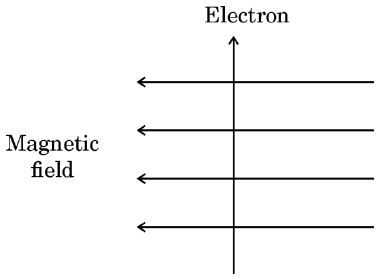 (I) What will be the direction of the force acting on the electron ?(II) What will happen to the direction of the force acting on the electron, if the direction of the magnetic field as well as the direction of motion of the electron, both are reversed ?
[CBSE 2026 31/3/1]
Solution:
(a)(i) A solenoid is a coil of many circular turns of insulated copper wire wrapped closely in the shape of a cylinder.Field pattern: inside the solenoid the field lines are straight and parallel (a uniform field); outside, they go from the N end round to the S end, like the field of a bar magnet.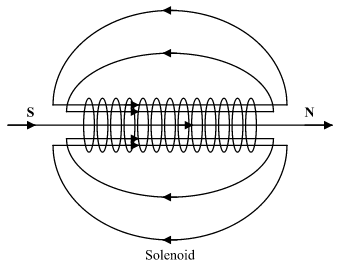 (a)(ii) Any two of:1. The current flowing through the solenoid (more current, stronger field).2. The number of turns of the coil (more turns, stronger field).3. The nature of the core material (a soft iron core makes it much stronger).(a)(iii) Around a straight current-carrying wire the field lines are concentric circles centred on the wire, in a plane perpendicular to it. By the right-hand thumb rule (thumb along the current), for a current flowing upward the field lines are anticlockwise when seen from above.
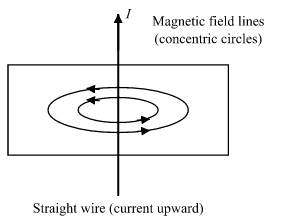 OR (b)(i) Activity: a small aluminium rod is hung horizontally between the poles of a horseshoe magnet and connected to a battery through a key. When the key is closed and current flows through the rod, the rod is displaced (it moves sideways). Reversing the current or the magnetic field reverses the direction of displacement. This shows that a current-carrying conductor in a magnetic field experiences a force.The direction of the force is given by Fleming's left-hand rule: stretch the forefinger, middle finger and thumb of the left hand mutually perpendicular; forefinger along the field, middle finger along the current, then the thumb gives the force. The force is perpendicular to both the field and the current.
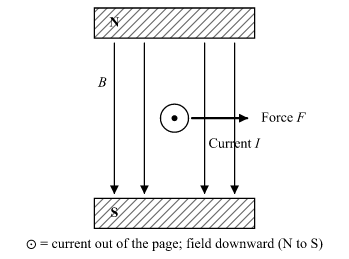 (b)(ii)(I) An electron is negatively charged, so the current is opposite to its motion: the current is downward (in the plane of the paper) and the field is towards the left.By Fleming's left-hand rule (forefinger to the left, middle finger downward), the thumb points into the plane of the paper. So the force on the electron acts into the paper.(b)(ii)(II) Reversing the field reverses the force, and reversing the motion (current) reverses it again. Two reversals cancel, so the direction of the force remains the same (into the paper).
© examsnet.com
Go to Question: