Test Index
Magnetic Effects of Electric Current
Magnetic Effects of Electric Current

 CBSE Board Videos
© examsnet.com
Question : 26 of 40
Marks:
+1,
-0
(A) (i) Why is an alternating current (A.C.) considered to be advantageous over direct current (D.C.) for the long distance transmission of electric power ?(ii) How is the type of current used in household supply different from the one given by a battery of dry cells ?(iii) How does an electric fuse prevent the electric circuit and the appliances from a possible damage due to short circuiting or overloading.OR(B) For the current carrying solenoid as shown, draw magnetic field lines and give reason to explain that out of the three points A, B and C, at which point the field strength is maximum and at which point it is minimum ?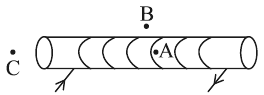
[CBSE 2023 31/4/2]
Solution:
(A)(i) Alternating current can be transmitted over long distances without much loss of electrical energy (its voltage can be stepped up for transmission and stepped down for use).(ii) Household supply is alternating current (AC): its direction reverses periodically (in India the frequency is 50 Hz, so it changes direction every s). A battery of dry cells gives direct current (DC), which always flows in one direction.(iii) A fuse is a wire of low melting point connected in series with the circuit. When short-circuiting or overloading makes the current rise above the rated value, the fuse wire heats up (Joule heating), melts and breaks the circuit. The current stops, so the circuit and appliances are protected.OR (B)Magnetic field lines of the current-carrying solenoid (direction shown by arrows; current direction marked):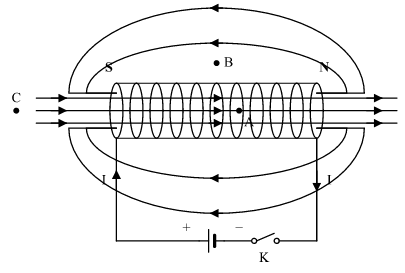 Maximum at A: A is inside the solenoid. The field lines there are parallel straight lines, crowded close together; the fields of all the turns add up, so the field is strong and uniform.Minimum at B: B is outside the solenoid near its middle. The field lines there are spread far apart, so the field is the weakest.(At C, beyond the end on the axis, the lines spread out after leaving the end, so the field is weaker than at A but stronger than at B.)
© examsnet.com
Go to Question: