Test Index
Magnetic Effects of Electric Current
Magnetic Effects of Electric Current

 CBSE Board Videos
© examsnet.com
Question : 2 of 40
Marks:
+1,
-0
Attempt either (a) or (b) :(a) (i) State the rule which gives the direction of force acting on a current-carrying conductor placed in a magnetic field.(ii) What is a fuse ? Why is it called a safety device ?(iii) Why are electrical appliances with metallic bodies connected to the mains through a three-pin plug, whereas an electric bulb is connected with a two-pin plug ?(iv)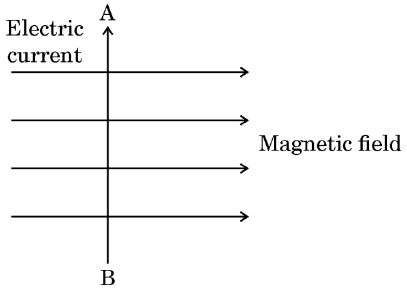 What will be the direction of force experienced by the conductor AB due to the magnetic field, when current flows in the direction shown ? Name the law you applied to find the direction.OR(b) (i) Draw the pattern of magnetic field lines through and around a current-carrying circular loop.(ii) State the rule to find out the direction of the magnetic field inside and around the circular loop.(iii) Give reasons :(I) Why should a burnt-out fuse be replaced by another fuse of identical rating only, in an electric circuit ?(II) Why is soft iron-core used in making an electromagnet ?
[CBSE 2026 31/2/1]
Solution:
(a)(i) Fleming's left-hand rule: Stretch the thumb, forefinger and middle finger of the left hand so that they are mutually perpendicular. If the forefinger points in the direction of the magnetic field and the middle finger in the direction of the current, then the thumb points in the direction of motion of (force on) the conductor.(a)(ii) A fuse is a piece of wire of a metal or alloy of low melting point (e.g. an alloy of tin and lead) connected in series with the live wire of a circuit or appliance.It is called a safety device because when the current exceeds the safe limit (due to overloading or a short circuit), the fuse wire heats up (heating effect of current), melts and breaks the circuit. This stops the current and protects the appliances and wiring from damage and fire.(a)(iii) A three-pin plug connects the metallic body of the appliance to the earth wire. If the live wire touches the metal body due to a fault, the earth wire provides a low-resistance path for the current to flow to the ground, keeping the body at earth potential, so the user does not get a severe electric shock.An electric bulb has no metal body that a person handles (its outer parts are glass and insulating material), so it needs no earthing and a two-pin plug (live and neutral) is enough.(a)(iv) In the figure, the current in AB flows upwards (from B to A) and the magnetic field acts from left to right. Applying Fleming's left-hand rule (forefinger to the right, middle finger upwards), the thumb points into the plane of the paper.Result: The force on AB acts perpendicular to the plane of the paper, into the paper. Law applied: Fleming's left-hand rule.OR (b)(i)Magnetic field lines of a current-carrying circular loop: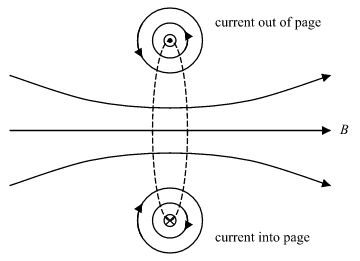 • Near the wire at each point where it crosses the paper, the field lines are concentric circles.• Towards the centre of the loop the circles become larger; at the centre the field lines are nearly straight and parallel, all pointing the same way (the field there is almost uniform).(b)(ii) Right-hand thumb rule: Imagine holding the current-carrying conductor (each part of the loop) in the right hand so that the thumb points in the direction of the current; then the curled fingers give the direction of the magnetic field lines. Applying it to every part of the loop shows that all parts produce field lines in the same direction inside the loop.(b)(iii)(I) A fuse of the correct (identical) rating melts exactly when the current exceeds the safe limit for that circuit. A fuse of higher rating would not melt on overloading, so the appliances and wiring could be damaged or catch fire; a fuse of lower rating would melt even at normal current and the appliance would not work.(II) Soft iron is magnetised strongly when current flows in the coil around it, which makes the electromagnet much stronger, and it loses its magnetism as soon as the current is switched off. So the electromagnet can be switched on and off as needed (steel would stay a permanent magnet).
© examsnet.com
Go to Question: