Test Index
Magnetic Effects of Electric Current
Magnetic Effects of Electric Current

 CBSE Board Videos
© examsnet.com
Question : 13 of 40
Marks:
+1,
-0
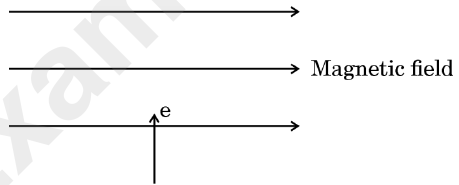
(a) The given figure shows the current passing through the straight conductor XY.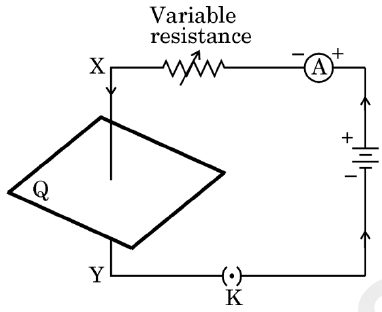 (i) Copy the diagram and draw the magnetic field lines when current flows from conductor X to Y.(ii) Name and state the rule used in determining the direction of the magnetic field lines in the situation given above.(iii) State Fleming's left hand rule. Using this rule, determine the direction of force applied on an electron entering a uniform magnetic field as shown in the figure.
 OR(b) (i) Define the term solenoid. Draw the pattern of the magnetic field lines in and around a current carrying straight solenoid. Mark on the pattern the (i) direction of current, (ii) direction of field lines near the ends of the solenoid, and (iii) region where the magnetic field is uniform.(ii) How would you make an electromagnet using a current carrying solenoid ?
[CBSE 2025 31/2/2]
Solution:
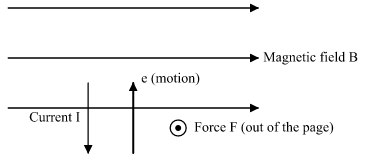
(a)(i)The magnetic field lines of a straight current-carrying conductor are concentric circles on the cardboard Q, centred on the wire, closer together near the wire. The current flows from X to Y, i.e. downwards through the cardboard, so seen from above the field lines run clockwise.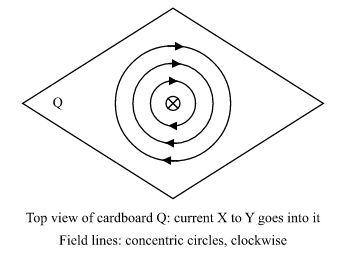 (a)(ii)Right-hand thumb rule: Imagine holding the current-carrying straight conductor in your right hand so that the thumb points in the direction of the current. Then the fingers wrapped around the conductor give the direction of the magnetic field lines.(Thumb pointing down from X to Y, the fingers curl clockwise when seen from above.)(a)(iii)Fleming's left-hand rule: Stretch the thumb, forefinger and middle finger of the left hand so that they are mutually perpendicular. If the forefinger points in the direction of the magnetic field and the middle finger in the direction of the current, then the thumb points in the direction of the force (motion) on the conductor.Applying it:Magnetic field: towards the right (in the plane of the paper).The electron moves upwards; an electron carries negative charge, so the conventional current is opposite to its motion, i.e. downwards.Forefinger to the right, middle finger downwards: the thumb points out of the plane of the paper (towards the reader).So the force on the electron is perpendicular to both the field and its motion, out of the page.
 OR (b)(i)A solenoid is a coil of many circular turns of insulated copper wire wrapped closely in the shape of a cylinder.Field pattern of a current-carrying solenoid:
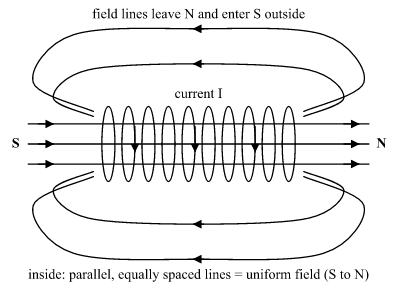 (i) Direction of current: shown by arrows on the turns (downward in the front part of each turn here).(ii) Near the ends: outside the solenoid the field lines come out of one end (N) and go into the other end (S), like a bar magnet; inside they run from S to N.(iii) Uniform field: inside the solenoid, where the field lines are straight, parallel and equally spaced.(b)(ii)Place a piece of soft iron (a soft iron rod) inside the solenoid and pass current through the coil. The strong uniform field inside magnetises the soft iron, so it becomes a strong magnet called an electromagnet. It stays a magnet only while the current flows.
© examsnet.com
Go to Question: