Test Index
Light – Reflection and Refraction
Light – Reflection and Refraction

 CBSE Board Videos
© examsnet.com
Question : 5 of 64
Marks:
+1,
-0
The variation of image distance () with the object distance () for a convex lens is given in the following observation table. Analyse it and answer the questions given below :
(a) Without calculation, find out the focal length of the given convex lens. Justify your answer. (1)(b) Which one of the observations given in the table is not correct and why ? (1)(c) (i) Find out the value of magnification for cm. Write the nature of the image formed. Give reason for your answer. (2)OR(c) (ii) Analyse the data given in the table above and draw the labelled ray diagram for cm and cm. (2)
| S.No. | Object distance () cm | Image distance () cm |
| 1 | ||
| 2 | ||
| 3 | ||
| 4 | ||
| 5 | ||
| 6 |
[CBSE 2026 31/3/1]
Solution:
(a) In observation 3, the object distance equals the image distance ( cm). A convex lens forms an image of the same size at the same distance only when the object is at , i.e. at a distance .So cm and cm.(b) Observation 6 is not correct. Here the object is at 15 cm, which is less than cm (between and O). A convex lens then forms a virtual, erect image on the same side as the object, so must be negative, not cm. (By the lens formula, cm.)(c)(i)Nature: real, inverted and magnified (5 times the size of the object).Reason: is negative, so the image is inverted (and a real image is inverted); , so it is enlarged. Also is positive, so the image is on the other side of the lens.OR (c)(ii) Here cm, so the object at 30 cm lies between and ; the image is formed beyond (at 150 cm) and is real, inverted and magnified.Ray 1: from A parallel to the principal axis; after refraction it passes through .Ray 2: from A through the optical centre O; it goes straight without deviation.They meet at A′; A′B′ is the image.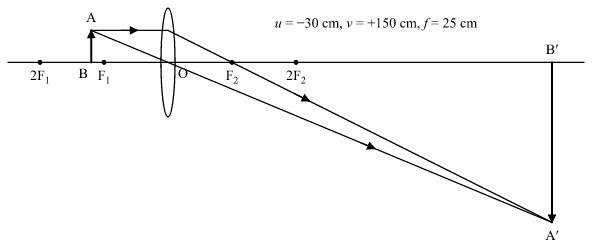
© examsnet.com
Go to Question: