Test Index
Light – Reflection and Refraction
Light – Reflection and Refraction

 CBSE Board Videos
© examsnet.com
Question : 30 of 64
Marks:
+1,
-0
Many optical instruments consist of a number of lenses. They are combined to increase the magnification and sharpness of the image. The net power (P) of the lenses placed in contact is given by the algebraic sum of the powers of the individual lenses asThis is also termed as the simple additive property of the power of lens, widely used to design lens systems of cameras, microscopes and telescopes. These lens systems can have a combination of convex lenses and also concave lenses.(a) What is the nature (convergent / divergent) of the combination of a convex lens of power and a concave lens of power ? (1)(b) Calculate the focal length of a lens of power . (1)(c) Draw a ray diagram to show the nature and position of an image formed by a convex lens of power , when an object is placed at a distance of from its optical centre. (2)OR(c) How is a virtual image formed by a convex lens different from that formed by a concave lens ? Under what conditions do a convex and a concave lens form virtual images ? (2)
[CBSE 2023 31/5/3]
Solution:
(a) Net power D. The net power is positive, so the combination behaves as a convex lens: it is convergent.(b) cmResult: Focal length cm (a concave lens).(c) cm. The object at cm lies between the optical centre O and the focus .So the image is virtual, erect and magnified, and it is formed on the same side of the lens as the object (behind the object).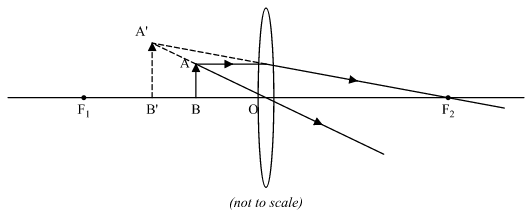 A ray from A parallel to the principal axis passes through after refraction; a ray through O goes straight. The refracted rays diverge; extended backwards, they meet at A′, giving the image A′B′.(By the lens formula, , so cm and : the image is just behind the object and only slightly larger. The diagram is not to scale.)OR (c)Difference: The virtual image formed by a convex lens is erect and magnified. The virtual image formed by a concave lens is erect and diminished.Conditions: A convex lens forms a virtual image only when the object is placed between its optical centre and principal focus (between O and ). A concave lens forms a virtual image for every position of the object, anywhere between the optical centre and infinity.
© examsnet.com
Go to Question: