Test Index
Light – Reflection and Refraction
Light – Reflection and Refraction

 CBSE Board Videos
© examsnet.com
Question : 23 of 64
Marks:
+1,
-0
A highly polished surface such as a mirror reflects most of the light falling on it. In our daily life we use two types of mirrors — plane and spherical. The reflecting surface of a spherical mirror may be curved inwards or outwards. In concave mirrors, reflection takes place from the inner surface, while in convex mirrors reflection takes place from the outer surface.(a) Define the principal axis of a concave mirror. (1)(b) A ray of light is incident on a concave mirror, parallel to its principal axis. If this ray after reflection from the mirror passes through the principal axis from a point at a distance of from the pole of the mirror, find the radius of curvature of the mirror. (1)(c) (i) An object is placed at a distance of from the pole of a convex mirror of focal length . Find the position of the image. (2)OR(c) (ii) A mirror forms a virtual, erect and diminished image of an object. Identify the type of this mirror. Draw a ray diagram to show the image formation in this case. (2)
[CBSE 2024 31/5/1]
Solution:
(a)The principal axis of a concave mirror is the straight line passing through its pole (P) and its centre of curvature (C).(b)A ray parallel to the principal axis passes, after reflection from a concave mirror, through the principal focus. So .(c) (i)Given: , (convex mirror)Mirror formula: Result: The image is formed behind the mirror (virtual and erect).OR (c) (ii)The mirror is a convex mirror (diverging mirror). It always forms a virtual, erect and diminished image, wherever the object is placed.Ray diagram: a ray from A parallel to the principal axis reflects as if coming from F; a ray from A directed towards C reflects back along its own path. The reflected rays appear to meet at A' behind the mirror.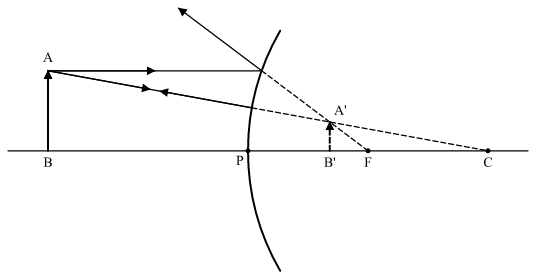 Image A'B': between P and F behind the mirror; virtual, erect and diminished.
© examsnet.com
Go to Question: