Test Index
Light – Reflection and Refraction
Light – Reflection and Refraction

 CBSE Board Videos
© examsnet.com
Question : 20 of 64
Marks:
+1,
-0
(a) The variation of image distance (v) with object distance (u) for a convex lens is given in the following observation table. Analyse it and answer the questions that follow :
(i) Without calculation, find the focal length of the convex lens. Justify your answer.(ii) Which observation is not correct ? Why ? Draw ray diagram to find the position of the image formed for this position of the object.(iii) Find the approximate value of magnification for cm.OR(b) (i) Define principal axis of a lens. Draw a ray diagram to show what happens when a ray of light parallel to the principal axis of a concave lens passes through it.(ii) The focal length of a concave lens is 20 cm. At what distance from the lens should a 5 cm tall object be placed so that its image is formed at a distance of 15 cm from the lens ? Also calculate the size of the image formed.
| S. No. | Object distance (u) cm | Image distance (v) cm |
| 1 | ||
| 2 | ||
| 3 | ||
| 4 | ||
| 5 | ||
| 6 |
[CBSE 2024 31/4/1]
Solution:
(a)(i) In observation 3, cm and cm: object and image distances are equal. For a convex lens this happens only when the object is at (and the image at ).So cm, giving cm.(ii) Observation 6 is not correct. For cm the object is between and the optical centre ( cm). The image is then virtual, erect and on the same side as the object, so must be negative, not cm.(Lens formula: , so cm.)Ray diagram: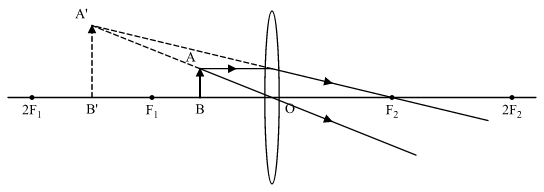 A ray from A parallel to the principal axis passes through after refraction; a ray through O goes straight. The refracted rays diverge; extended backwards, they meet at A′. The image A′B′ is virtual, erect and magnified, on the same side as the object.(iii) For cm, cm:The image is real, inverted and about 5 times the size of the object.OR (b)(i) Principal axis: The imaginary straight line passing through the two centres of curvature of the two spherical surfaces of a lens.A ray parallel to the principal axis, after refraction through a concave lens, diverges and appears to come from the principal focus on the same side of the lens:
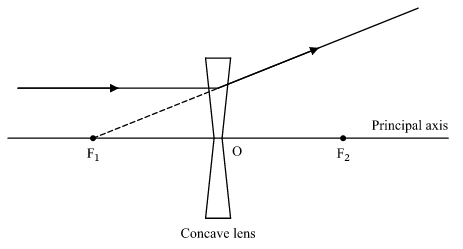 (ii)Given: cm (concave), cm (virtual image on the object side), cmLens formula: cmSize of image: cmResult: The object must be placed cm from the lens; the image is cm tall (virtual and erect).
© examsnet.com
Go to Question: