Test Index
Light – Reflection and Refraction
Light – Reflection and Refraction

 CBSE Board Videos
© examsnet.com
Question : 14 of 64
Marks:
+1,
-0
(a) (i) The power of a lens 'X' is D. Name the lens and determine its focal length in cm. For which eye defect of vision will an optician prescribe this type of lens as a corrective lens ?(ii) \"The value of magnification 'm' for a lens is .\" Using new Cartesian Sign Convention and considering that an object is placed at a distance of 20 cm from the optical centre of this lens, state :(I) the nature of the image formed;(II) size of the image compared to the size of the object;(III) position of the image, and(IV) sign of the height of the image.(iii) The numerical values of the focal lengths of two lenses A and B are 10 cm and 20 cm respectively. Which one of the two will show higher degree of convergence/divergence ? Give reason to justify your answer.OR(b) (i) Draw a ray diagram to show the refraction of a ray of light through a rectangular glass slab when it falls obliquely from air into glass.(ii) State Snell's law of refraction of light.(iii) Differentiate between the virtual images formed by a convex lens and a concave lens on the basis of :(I) object distance, and(II) magnification.
[CBSE 2025 31/1/1]
Solution:
(a)(i)The power is negative, so the lens is a concave (diverging) lens.Result: concave lens, focal length cm (written cm).A concave lens is used to correct myopia (near-sightedness): it diverges the rays so that the image of a distant object forms on the retina.(a)(ii), with cm.(I) is negative, so the image is real and inverted (only a convex lens gives this).(II) : the image is magnified, twice the size of the object.(III) cm: the image is cm from the lens on the other side of the lens. (Then , cm, so the object is between and and the image is beyond .)(IV) The image is inverted, so its height is negative.(a)(iii): D, D (in magnitude).Lens A (focal length cm) shows the higher degree of convergence/divergence, because the power of a lens (its ability to bend light) is the reciprocal of its focal length: the shorter the focal length, the greater the power.OR (b)(i)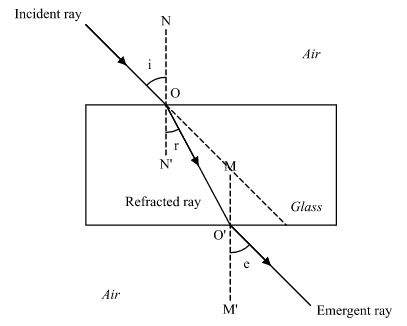 The ray bends towards the normal on entering glass at O () and away from the normal on leaving glass at O'. The emergent ray is parallel to the incident ray () but shifted sideways (lateral displacement).(b)(ii)Snell's law: for light of a given colour and a given pair of media, the ratio of the sine of the angle of incidence to the sine of the angle of refraction is a constant.(The incident ray, the refracted ray and the normal at the point of incidence also lie in the same plane.)(b)(iii)
| Basis | Virtual image by convex lens | Virtual image by concave lens |
| (I) Object distance | Only when the object is between the optical centre O and the focus | For any position of the object in front of the lens |
| (II) Magnification | Image is enlarged: (positive) | Image is diminished: (positive) |
© examsnet.com
Go to Question: