Test Index
Light – Reflection and Refraction
Light – Reflection and Refraction

 CBSE Board Videos
© examsnet.com
Question : 10 of 64
Marks:
+1,
-0
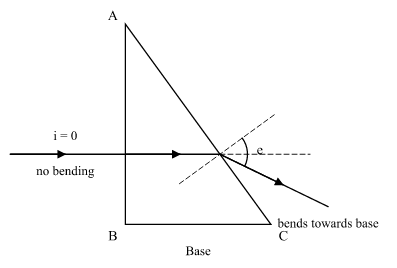
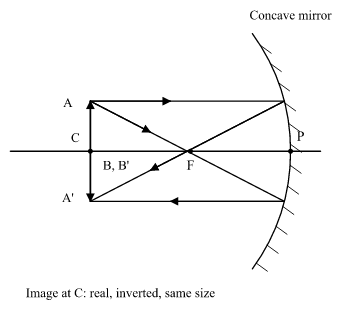
(a) (i) “In refraction of light through a rectangular glass slab, the emergent ray is always parallel to the direction of the incident ray.” Why ? Explain with the help of a ray diagram. What happens when a ray of light falls normally on one of the faces of a rectangular glass prism ? Draw diagram.(ii) An object is placed at a distance of cm from the optical centre of a concave lens of focal length cm. Use Lens formula to determine the position of the image formed in this case.OR(b) (i) A student wishes to study the image formation by a concave mirror using candle flame as object. State the type of the image formed by the mirror and mention the change in the image formed, if any, that he observes when the candle flame is gradually moved away from the pole of the mirror. Draw a ray diagram to show the image formation when the object distance is nearly equal to the radius of curvature of the mirror.(ii) A convex mirror used for rear-view on an automobile has a focal length of m. If a bus is located at m from this mirror, use mirror formula to find the position of the image of the bus as seen in the mirror.
[CBSE 2025 31/3/2]
Solution:
(a)(i)Why the emergent ray is parallel to the incident ray:1. At the upper face (air to glass) the ray bends towards the normal: angle of incidence , angle of refraction , with (refractive index of glass).2. The two faces of the slab are parallel, so the two normals are parallel. The refracted ray meets the lower face at the same angle (alternate angles).3. At the lower face (glass to air) the ray bends away from the normal. Since too, , so .4. The emergent ray therefore makes the same angle with the normal as the incident ray: it is parallel to the incident ray, only shifted sideways (lateral displacement ).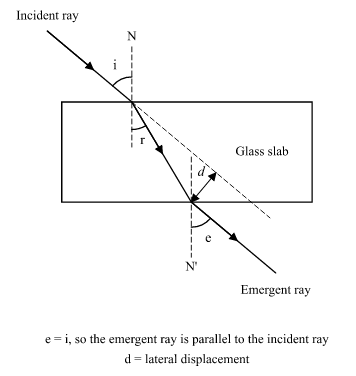 Ray falling normally on a face of a glass prism:A ray incident along the normal () enters the glass without bending (angle of refraction ). It then meets the second (inclined) face obliquely; there it passes from glass to air and bends away from the normal, that is, towards the base of the prism.
 (a)(ii)Given: concave lens, cm, cm (focal length of a concave lens is negative)Lens formula: cmMagnification Result: The image is formed cm from the optical centre on the same side as the object (negative ); it is virtual, erect and diminished ( times the object).OR (b)(i)Type of image: With the candle flame beyond the focus, the concave mirror forms a real and inverted image that can be taken on a screen. (Very close to the mirror, between and , the image is virtual, erect and enlarged and cannot be obtained on a screen.)Change as the flame is moved away from the pole:Between and : virtual, erect, enlarged; the image grows larger as the flame nears .At : image at infinity (highly enlarged).Between and : real, inverted, enlarged, formed beyond .At : real, inverted, same size, at .Beyond : real, inverted, diminished, between and ; it becomes smaller and moves towards as the flame goes farther away.So the image changes from virtual and erect to real and inverted, and the real image becomes smaller and comes closer to the focus as the flame moves away.Ray diagram (object at about , i.e. ):A ray from the top of the flame parallel to the principal axis passes through after reflection; a ray through becomes parallel to the axis after reflection. They meet at : the image is formed at , real, inverted and of the same size as the object.
 (b)(ii)Given: convex mirror, m, mMirror formula: mMagnification Result: The image of the bus is m behind the mirror; it is virtual, erect and diminished (one-third the size of the bus).
© examsnet.com
Go to Question: