Test Index
Life Processes
Life Processes

 CBSE Board Videos
Show Para
Question Numbers: 53-56Case-II:The figure shown below represents a common type of dialysis called as Hemodialysis. It removes waste products from the blood, such as excess salts and urea which are insufficiently removed by the kidney in patients with kidney failure. During the procedure, the patient's blood is cleaned by filtration through a series of semi-permeable membranes before being returned to the blood of the patient. On the basis of this, answer the following questions: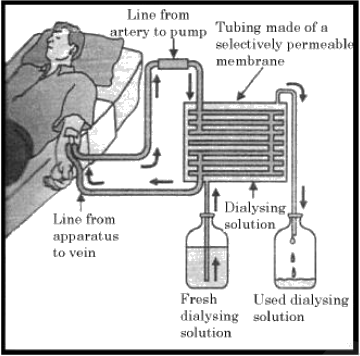
© examsnet.com
Question : 87 of 89
Marks:
+1,
-0
Which one of the following is not a function of Artificial Kidney?
[CBSE 2021 Term 1]
Solution:
Concept:In an artificial kidney (haemodialysis), blood flows through long tubes with a semi-permeable lining placed in a tank of dialysing fluid. The fluid has the same osmotic pressure as blood but no nitrogenous wastes, so wastes diffuse out of the blood into the fluid. The purified blood is pumped back into the patient.Explanation:The artificial kidney removes nitrogenous wastes and excess fluid and so filters and purifies the blood.Unlike a real kidney, it has no reabsorption. In the nephron, useful substances (glucose, amino acids, salts, water) are reabsorbed in the tubules, but the dialyser cannot do this.Answer:Option C (To reabsorb essential nutrients from the blood.)
© examsnet.com
Go to Question: