Test Index
How do Organisms Reproduce?
How do Organisms Reproduce?

 CBSE Board Videos
© examsnet.com
Question : 9 of 41
Marks:
+1,
-0
(a) (i) Identify the parts ‘X’ and ‘Y’ in the figure given below :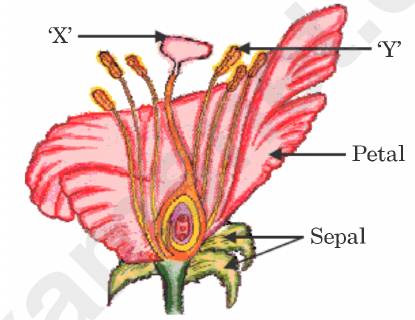 (ii) Name the yellowish coloured structures produced by the part labelled as ‘Y’.(iii) Write the name of the process by which these are transferred to the part labelled as ‘X’.(iv) Explain the process of seed formation in a flowering plant.OR(b) (i) Name the type of asexual mode of reproduction shown in the given figure.
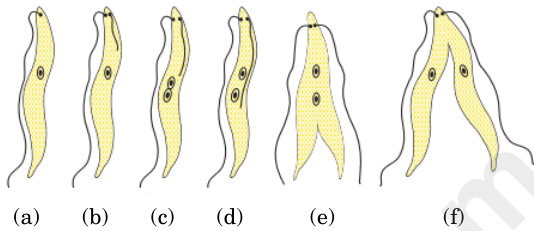 (ii) Identify the unicellular organism in the diagram.(iii) List any two advantages of asexual reproduction over sexual reproduction.(iv) Name and explain any one mode of asexual reproduction observed in Hydra.
[CBSE 2025 31/3/2]
Solution:
(a)(i)X = Stigma (top of the pistil, sticky surface that receives pollen)Y = Anther (top of the stamen)(a)(ii)The anther produces pollen grains, the yellowish powdery structures that contain the male germ cells.(a)(iii)Pollination: the transfer of pollen grains from the anther to the stigma (self-pollination in the same flower, cross-pollination to another flower by wind, water or animals).(a)(iv) Seed formation:1. After pollination the pollen grain on the stigma germinates and a pollen tube grows out of it.2. The pollen tube grows down through the style and reaches the ovule in the ovary.3. The male germ cell carried in the tube fuses with the female germ cell (egg) in the ovule: fertilisation, giving a zygote.4. The zygote divides several times to form an embryo within the ovule.5. The ovule develops a tough coat and changes into a seed; the ovary grows and ripens into a fruit. Petals, sepals, stamens, style and stigma shrivel and fall off.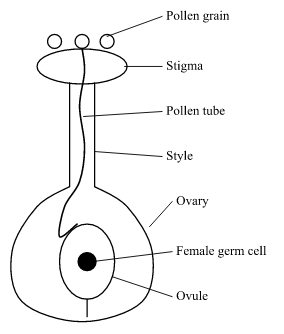 OR (b)(i)The figure shows binary fission: the single cell divides into two daughter cells. Here the splitting takes place in a definite plane (lengthwise, with respect to the flagellum at one end).(b)(ii)The organism is Leishmania (the protozoan that causes kala-azar).(b)(iii) Advantages of asexual reproduction (any two):1. Only one parent is needed; no gametes or mates have to be found.2. It is fast: a large number of offspring are produced in a short time.3. The offspring are nearly identical to the parent, so useful traits of a well-adapted parent are kept.(b)(iv)Budding in Hydra: due to repeated cell division at one specific site of the body, a small outgrowth called a bud develops. The bud grows into a tiny individual with its own tentacles and mouth, and when fully mature it detaches from the parent and lives as a new, independent Hydra.(Hydra also shows regeneration: if its body is cut into pieces, each piece can grow into a complete organism; either mode is a correct answer.)
© examsnet.com
Go to Question: