Test Index
How do Organisms Reproduce?
How do Organisms Reproduce?

 CBSE Board Videos
© examsnet.com
Question : 4 of 41
Marks:
+1,
-0
Attempt either (a) or (b) :(a) Observe the given diagram and answer the questions that follow :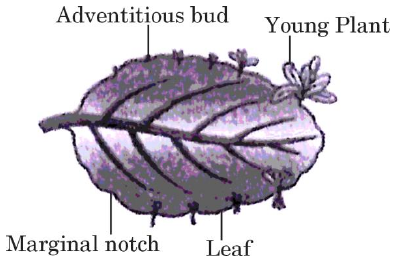 (i) Give the name of the structure and type of reproduction shown in the above diagram.(ii) State one advantage and one disadvantage of the above mentioned method of reproduction.(iii) Give reason : Asexual reproduction lacks genetic variation.(iv) Why have higher organisms resorted to sexual reproduction in spite of its complexity ?OR(b) Observe the given diagram and answer the questions that follow :
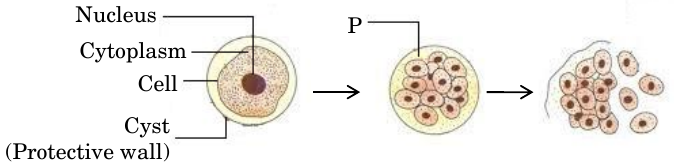 (i) Give the name and type of reproduction shown in the above diagram.(ii) Comment on the processes taking place in stage P.(iii) Name an organism which reproduces by the above mentioned method.(iv) Name the method that can be used to raise plants that have lost their capacity to produce seeds. List any two advantages of growing plants by such a method.
[CBSE 2026 31/3/1]
Solution:
(a)(i)Structure: leaf of Bryophyllum with buds in the notches along its margin.Type of reproduction: vegetative propagation (asexual reproduction) by leaves. The buds fall on the soil and develop into new plants.(a)(ii)Advantage (any one): the new plants are genetically identical to the parent, so desirable traits are kept; such plants bear flowers and fruits earlier than plants grown from seeds; plants that have lost the capacity to produce seeds (banana, orange, rose, jasmine) can be grown.Disadvantage: there is no genetic variation, so all the plants are equally likely to be wiped out by a disease or a change in the environment.(a)(iii)Asexual reproduction involves only a single parent and no fusion of gametes. The offspring are formed by mitotic division, so they receive copies of the same DNA as the parent. Apart from small errors in DNA copying, the offspring are genetically identical, so there is (almost) no variation.(a)(iv)Sexual reproduction combines DNA from two different individuals, so it creates new combinations of genes (genetic variation) in every generation. Variation increases the chances of survival of the species in a changing environment and is the basis of evolution. That is why higher organisms use it in spite of its complexity.OR (b)(i)Name: multiple fission.Type: asexual reproduction.(b)(ii)In stage P, the single cell inside the protective cyst wall divides repeatedly: the nucleus divides many times, and then the cytoplasm divides around each nucleus. Thus many daughter cells are formed at the same time inside the cyst; when the cyst bursts, they are released.(b)(iii)Plasmodium (the malarial parasite) reproduces by multiple fission.(b)(iv)Method: vegetative propagation (e.g. by layering, grafting or cuttings), used for plants such as banana, orange, rose and jasmine that have lost the capacity to produce seeds.Advantages (any two):1. All the plants produced are genetically similar to the parent plant, so they have all its desirable characters.2. Such plants can bear flowers and fruits earlier than those produced from seeds.3. It is a quick and easy way to raise many plants from one parent.
© examsnet.com
Go to Question: