Test Index
Heredity
Heredity

 CBSE Board Videos
© examsnet.com
Question : 32 of 36
Marks:
+1,
-0
The mechanism by which the sex of an individual is determined is called sex-determination. In human beings, sex of a newborn is genetically determined, whereas in some others it is not. There are 46 (23 pairs) chromosomes in human beings. Out of these, 44 (22 pairs) control the body characters and 2 (one pair) are known as sex chromosomes. The sex chromosomes are of two types — X chromosome and Y chromosome. At the time of fertilisation, depending upon which type of male gamete fuses with the female gamete, the sex of the newborn child is decided.(a) What is the statistical probability of getting either a male or a female child ? Justify your answer. (½ + ½)(b) Out of male or female, which of them has a perfect pair of sex chromosomes ? In case of a perfect pair, will the gametes produced be of the same kind or of a different kind ? (1)(c) (i) Name two animals whose sex is not genetically determined. Explain the process of their sex determination. (1+1)OR(c) (ii) With the help of a flowchart only, show how sex is genetically determined in human beings. (1+1)
[CBSE 2022 31/1/3]
Solution:
(a) The probability of getting a male or a female child is 50% each (1 : 1).Justification: The mother (XX) makes only one kind of egg, each with an X chromosome. The father (XY) makes two kinds of sperms in equal numbers, half with X and half with Y. All children inherit an X from the mother. A child who inherits X from the father is a girl (XX); one who inherits Y is a boy (XY). Both kinds of sperm have an equal chance of fertilising the egg.(b) The female has a perfect pair of sex chromosomes (XX). The gametes (eggs) produced are all of the same kind: each carries one X chromosome.(c)(i)Animals whose sex is not genetically determined: some reptiles (e.g. turtles, crocodiles) and snails.1. In some reptiles, the temperature at which the fertilised eggs are kept determines whether the animal developing in the egg will be a male or a female.2. In snails, individuals can change their sex during their lifetime, so sex is not genetically determined.OR (c)(ii)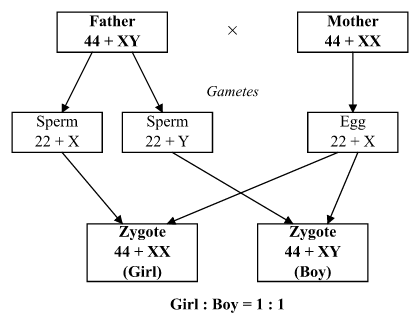
© examsnet.com
Go to Question: