Test Index
Heredity
Heredity

 CBSE Board Videos
© examsnet.com
Question : 27 of 36
Marks:
+1,
-0
In some families, either rural or urban, females are tortured for giving birth to a female child. They do not seem to understand the scientific reason behind the birth of a boy or a girl. In fact the mother is not responsible for the sex of the child and it has been genetically proved that the sex of a newborn is determined by what the child inherits from the father.(a) State the basis on which the sex of a newborn baby is determined in humans. (1)(b) Why is the pair of sex chromosomes called a mismatched pair in males ? (1)(c) How is the original number of chromosomes present in the parents restored in the progeny ? (2)OR(c) Explain by giving two examples of the organisms in which the sex is not genetically determined. (2)
[CBSE 2023 31/5/3]
Solution:
(a) In humans the sex of the child is determined by the sex chromosomes it inherits. The mother (XX) gives only X chromosomes in her eggs. The father (XY) gives either an X or a Y chromosome in his sperm.If a sperm carrying X fertilises the egg, the child is XX: a girl.If a sperm carrying Y fertilises the egg, the child is XY: a boy.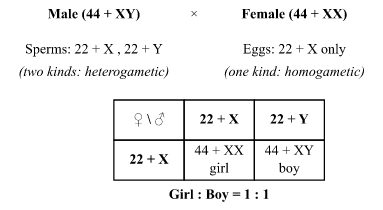 (b) In males the two sex chromosomes are not alike: one is a normal-sized X and the other is a short Y chromosome. So the pair is called a mismatched pair.(c)1. When the germ cells (gametes) are formed, the number of chromosomes is reduced to half. Each human gamete has only 23 chromosomes, one from each pair.2. At fertilisation, a gamete from each parent fuses. The zygote gets chromosomes, so the original number of chromosomes of the parents is restored in the progeny.OR (c)1. Some reptiles: The temperature at which the fertilised eggs are kept determines whether the animals developing in the eggs will be male or female (for example, in turtles and crocodiles).2. Snails: Individuals can change sex during their lifetime, so sex is not genetically determined.
© examsnet.com
Go to Question: