Test Index
Heredity
Heredity

 CBSE Board Videos
© examsnet.com
Question : 18 of 36
Marks:
+1,
-0
Mendel crossed pure tall pea plants (TT) with pure short pea plants (tt) and obtained progeny. When the plants of progeny were self-pollinated, plants of progeny were obtained.(a) What did the plants of progeny look like ? Give their gene combination.(b) Why could the gene for shortness not be expressed in plants of progeny ?(c) Write the ratio of the plants obtained in progeny and state the conclusion that can be drawn from this experiment.
[CBSE 2024 31/5/1]
Solution:
(a)All the plants of the progeny were tall. Their gene combination is Tt (one T from the tall parent and one t from the short parent).(b)Shortness (t) is a recessive trait. In Tt plants the dominant gene T for tallness is present, and it masks the recessive gene t. So the gene for shortness is present but cannot be expressed.(c)Self-pollination of : Tt Tt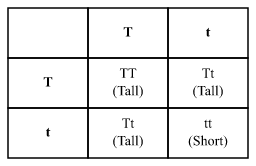 Phenotypic ratio in : Tall : Short (genotypes TT : Tt : tt ).Conclusion: Tallness is the dominant trait and shortness is the recessive trait. The trait for shortness was not lost in ; it was only hidden and reappeared in , so the two copies of a trait separate and are inherited independently.
© examsnet.com
Go to Question: