Test Index
Heredity
Heredity

 CBSE Board Videos
© examsnet.com
Question : 13 of 36
Marks:
+1,
-0
The lowest part of the ear called earlobe, is closely attached to the side of the head in some of us (Figure ‘X’), and not in others, called free earlobe (Figure ‘Y’). Attached and free earlobes are two variants found in human populations. The gene for free earlobe is dominant over attached earlobes.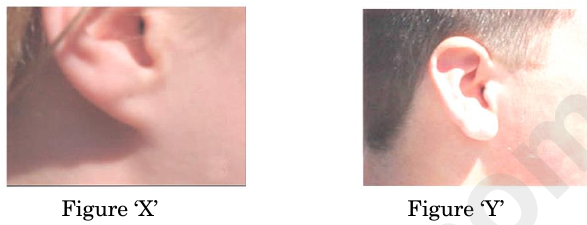 (a) A man with attached earlobes marries a woman having free earlobes. 50% of their children have free earlobes and 50% have attached earlobes. Explain the inheritance of this trait and write the trait combinations of the progeny.(b) Write the gene combinations of the father and the mother in the above case.
[CBSE 2025 31/2/2]
Solution:
Concept:Let F = gene for free earlobe (dominant) and f = gene for attached earlobe (recessive). An attached earlobe appears only when both copies are f (ff).(a)The father has attached earlobes, so he is ff and all his gametes carry f.Half the children have attached earlobes (ff), so each of them got an f from the mother too. The mother has free earlobes, so she must carry one F and one f, i.e. she is heterozygous (Ff), and makes F and f gametes in equal numbers.
Progeny: Ff (free earlobe) : ff (attached earlobe) , i.e. 50% free and 50% attached.Each child gets one copy of the gene from each parent; the dominant F shows its effect whenever present.(b)Father: ff (homozygous recessive, attached earlobe)Mother: Ff (heterozygous, free earlobe)Key point: If the mother were FF, all the children would be Ff with free earlobes; the 50 : 50 ratio proves she is Ff.
| Gametes | F (mother) | f (mother) |
| f (father) | Ff (free) | ff (attached) |
© examsnet.com
Go to Question: